Showing posts with label art history. Show all posts

Tuesday, 19 February 2019

Travel Tuesday: Treasures of the Egyptian Museum

Shabtis were put in tombs to act as servants in the afterlife.

As I mentioned in my previous post, I got back from Egypt last week, which means I have plenty of pictures for Travel Tuesday posts!

When I'm in Cairo I always reserve a couple of afternoons to wander around the National Museum. It's absolutely huge and no matter how many times I go there, I always see something new. A new National Museum is being constructed on the Giza Plateau near the pyramids. I passed the building the last time I went up there. It's a sleek, modern building that's even bigger than the existing museum. As with many government projects, it's behind schedule, but when it finally opens it promises to be stunning. In the meantime, we have the old museum to enjoy.

Stela of the Buchis Bull, showing one of the Ptolemaic pharaohs giving offerings to the sacred bull in their burial place in Armant. The Buchis bulls were manifestations of the god Ptah.

Two male figurines made of gold during the Late Predynastic period. Yep, these two guys are older than the oldest pharaoh!
Column of painted limestone carved to look like a lotus flower.

Tuesday, 4 December 2018

Travel Tuesday: A Medieval Synagogue in Córdoba, Spain

The entrance to the synagogue. The gallery above the entrance was reserved for women, who were kept out of sight of the men praying downstairs.

I just got back from Córdoba, a fascinating medieval town in southern Spain that was the capital of Islamic Spain for many years and remained important in the Middle Ages and Renaissance. A hallmark of the city during its Islamic rule was the large Jewish community, which got kicked out in 1492 when King Ferdinand and Queen Isabella expelled all the Jews and Muslims after completing the Reconquista.

Luckily a synagogue built in 1315, at the high point of Andalusian Jewish culture, has been remarkably preserved. Its decoration was common for Spanish synagogues of the time, incorporating complex plaster work in the Islamic style. After 1492, the building was used as a hospital and later a shoemaker's guild. At some point the plaster work was covered over, hiding it but also preserving it. In 1884, as the building fell into decay, some of this later mortar work fell away and the earlier decoration revealed. The synagogue was declared a national monument a year later.

The decoration is similar to a synagogue in Tangier I visited a couple of years ago. Click the link for more about that.

 
A closeup of the arch. Note the cross that was added later.


Friday, 26 October 2018

Military History Photo Friday: Decorative Shields in the Uffizi Gallery

Medusa on shield, painted by Caravaggio c. 1595-98. It brings to mind the Classical tale of how Perseus beheaded Medusa and later gave the head to the goddess Athena, who put it on her shield. This piece was a gift from Cardinal Francesco Maria del Monte to Grand Duke Ferdinando I in 1598.


Shortly after my last trip to Tangier, I got to spend a few days in Florence. Besides brushing off a pickpocket and admiring some grotesque art, I also spent a wonderful day in the famous Uffizi Gallery. They have a fine collection of Classical and Renaissance art. Of interest to military historians are two decorative shields. Of course these would have never seen a battle, but were rather for parades or simply hanging on the wall.

The back of the Medusa shield.

A buckler (small shield) with spike and etched decoration. Made c. 1570-80 by an unknown artist, it was kept in the Medici Armory together with the Medusa shield.

Tuesday, 10 July 2018

Travel Tuesday: Nabatean Funerary Stelae


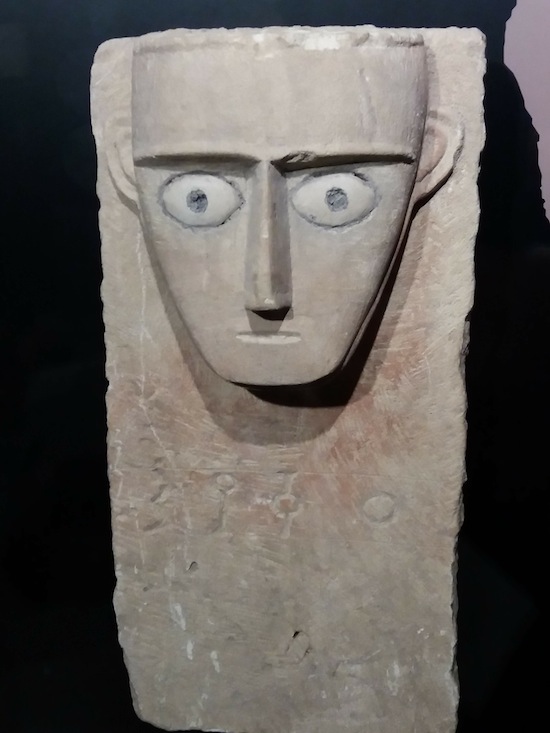
A couple of weeks ago I visited Málaga in the south of Spain. Besides a couple of castles, which I blogged about here, I also saw the Ifergan Gallery, an interesting private collection of ancient art. Among the collection were these Nabatean Funerary Stelae.

The Nabatean civilization thrived from the 4th century BC until it was absorbed into the Roman Empire by Trajan in 106 AD. They lived in the Levant and Arabian Peninsula and controlled the trade routes connecting the Persian Gulf, Red Sea, and Mediterranean. Remains of several of their cities can still be found in the deserts, including the famous site of Petra in Jordan.

One feature of their art was these enigmatic stone faces. They were placed on tombs and bore the names of the deceased. Similar stones were used to depict the gods in temples, although they tended to have more realistic features.


Tuesday, 14 February 2017

Happy Valentine's Day from Ancient Egypt!


This happy couple is a rare example of a double shabti. A shabti was a figurine placed in an ancient Egyptian tomb that would act as a servant in the afterlife. They come in a remarkable number and variety, but seeing double ones like this are rare. In fact I don't think I've seen one before. This example dates from the 19th or 20th dynasties (1295-1069 BC) and is made of faience. I spotted it in the archaeological museum of Bologna, which also has an incredible Etruscan collection that I've written about over on Black Gate. You can see some more examples of shabtis in a post I did about London's Petrie Museum on the same blog.

It kind of sucks that this happy couple has to labor ceaselessly for all eternity for some dead Egyptian noble but hey, at least they have each other!

Friday, 6 January 2017

Feliz Día de los Reyes Magos!


Today is the day of the three kings here in Spain, coinciding with Epiphany, when the three kings or wise men brought gifts in the baby Jesus. It always made more sense to me to give gifts on this day than Christmas, and that's what the Spanish do. There's also a huge meal, because no Spanish holiday goes by without a huge meal. We get a huge meal on Christmas Eve, Christmas, New Year's Eve, the night before Día de los Reyes Magos, etc. As you can imagine, I've been hitting the gym pretty hard to compensate.

This photo is from the Basilica of Sant' Apollinare Nuovo, built by the Ostrogothic King Theodoric in 504 AD. It's decorated in the early Byzantine style with lovely gold mosaics that no photo can really do justice to. Ravenna is filled with early church art and you'll be seeing plenty of it on this blog in the weeks to come.

The Three Kings are really popular here in Spain, and there's a big parade for them every year. It's interesting that there's been some changes in how they're depicted since the 6th century. Balthazar, the swarthy fellow on the left, is said to have come from Ethiopia. In this mosaic he's almost white. Until recent years he was portrayed in Spain by a guy in blackface. Thankfully now he's played by an actual African. Melchior is played by an old man and Gaspar by a young man, but in this mosaic the roles are reversed. I wonder why that happened?

¡Feliz Día de los Reyes Magos!

Thursday, 27 October 2016

Book Review: Islamic Art by David Talbot Rice

Islamic ArtIslamic Art by David Talbot Rice
My rating: 3 of 5 stars

This is a classic and much-reprinted primer on the highlights of Islamic art. I got the 1975 revised Thames & Hudson edition for free at a library giveaway (yippee!) so this is the edition I'm reviewing. I found the text clear and wide ranging. While it didn't go into as much detail as I would have liked, this is meant as a short introduction to a huge subject and does that quite well. I've studied Islamic art in a casual way for 25 years now and I still learned a lot from the text.

My main complaint is that the illustrations aren't up to par. Most are in somewhat grainy black and white and don't do these magnificent works of art justice. Even some of the images of illustrated manuscripts are in black and white. There are several color plates in this book but they are not of terribly good quality. I recommend this book for anyone looking to learn more about one of the world's great art traditions, but suggest that you look for a later, better illustrated edition.

View all my reviews

Monday, 7 December 2015

Travel Tuesday: Roman Mosaics in Morocco

Venus and Adonis.
Morocco became part of the Roman Empire in 40 AD as the province of Mauretania Tingitana. There are several good archaeological sites in the country, including the famous city of Volubilis and several smaller cities such as Lixus.

In the archaeological museum of Tetouan, there are a number of fine mosaics from Lixus. Originally a Phoenician city founded in the 7th century BC, it prospered under Roman rule. The mosaics you see here were all made in the 2nd and 3rd centuries AD. Life wasn't always peaceful in Roman Mauretania Tingitana, however, as you can see from this picture of a most unfortunate Roman soldier.

For some more shots of this kind of art, check out my post on Roman gladiator mosaics.

Mars and Rhea Silvia.
The three graces.

Tuesday, 15 September 2015

Travel Tuesday: Siberian shaman costumes


I was asked by the owner of a shamanism website if he could use some photos of mine from an article I did on the Art of Shamanism. It's so nice when people actually ASK to reuse your online photos! Specifically the website is about Tiger Bells, an interesting aspect of Asian art. The page with my photo is here. It's an extensive site and well worth looking at!


Tuesday, 26 May 2015

Travel Tuesday: Medieval Paintings in Salamanca Cathedral, Spain

Christ enthroned above the terrors of Hell.

In my last Travel Tuesday post, I shared some photos of Spanish heraldry from Salamanca. This medieval university town is filled with early art. The cathedral is full of medieval wall paintings dating to the 13th and 14th century.

Jump the cut for more photos!


Tuesday, 17 March 2015

Travel Tuesday: Exploring Ancient Hatra


This charming sculpture of a nursing baby camel probably doesn't exist anymore. It's from Hatra, an ancient city in Iraq that's probably the oldest city founded by Arabs, dating to the 3rd century BC. Unfortunately, it's in the area controlled by ISIS and they recently trashed this ancient site. I write more about it over at Black Gate in the article, Ancient Hatra: Another Victim of ISIS. Like with the Assyrian sites of Nimrud and Nineveh, these are archaeological wonders I was lucky enough to see when I was in Iraq back in 2012, before the nightmare of ISIS was unleashed on the world.

Tuesday, 3 February 2015

Travel Tuesday: A Templar Church and Prehistoric Paintings in Soria, Spain


In the Spanish province of Soria there's a narrow valley called El Cañon del Rio Lobos that leads to this, La Ceuva de San Bartolomé. On its walls are faint Bronze Age drawings, so faint I couldn't get a good shot of them. Sorry! They're hard to interpret anyway. They're mostly vertical or zigzag lines, some of which look vaguely human.

From out of the cave you see the Ermita de San Bartolomé, a late Romanesque church from the 13th century. It's said to have been built on an earlier Templar church in the 11th century and was the center for the military order of holy knights who defended the Soria branch of the Camino Santiago. Local tradition says the mystical Santiago (St. James) himself appeared and threw his sword into the canyon, declaring that wherever it landed a church should be built for the Templars.

Thursday, 8 January 2015

Muslim Depictions of the Prophet Muhammad


Considering recent events, this is a good time to point out that the ban on depictions of the Prophet Muhammad are not universal in Islam. There have been eras in the past where Muhammad was depicted in visual form, and he continues to be depicted in parts of the Muslim world today.

The above picture is taken from the Siyer-i Nebi: The Life of the Prophet, written in Cairo circa 1388 and illustrated in Constantinople (modern Istanbul) in 1595. The book contains several images of Muhammad. This one shows him and his followers marching on Mecca accompanied by angels. In all of the images the prophet's face is covered. More illustrations from the book can be seen at the website for Bilkent University in Turkey.

The University of Bergen also has a webpage of Muslim art show Muhammad. One of them is this Shia image from Iran. Most Persians have never followed the belief that Muslims are forbidden to create images of humans, and this has extended to including Muhammad in their art. Most Sunni believe that such depictions are wrong, but as the Ottoman image proves, this hasn't always been the case.

Thursday, 18 September 2014

Forgotten Masters of Fantasy and Science Fiction Silent Film

Satan at Play, bu Segundo de Chomón, 1907.

As you may know, I blog every Wednesday over at Black Gate. For the past two weeks I've been delving into my love of silent film. Ever since I was a kid I've been captivated by these early movies and as an adult I've been doing some research into them. Two early directors who have been all but forgotten are the subject of my recent posts.

Segundo de Chomón was a Spanish director who in the first decade of the twentieth century made some two hundred films, mostly fantasy and horror. Walter R. Booth of England was another early pioneer, starting in films in 1899. He created the first science fiction film trilogy with his Airship Destroyer series from 1909-11.

Both directors used techniques such as animation, split screen, jump cuts, superimposition, multiple exposures, and stop motion animation to make their special effects. Even though their films are more than a century old, many of these effects hold up surprisingly well. Check out the links to the articles and you'll find more links to their best films. Most early films were less than six minutes long so they make a perfect break from work. Enjoy!

Friday, 11 July 2014

Military History Photo Friday: Roman Gladiator Mosaics

OK, this isn't strictly military history, but these guys had a shorter lifespan than most combat units! Of course they got to be stars before being gutted in front of a cheering crowd, so that's some compensation I guess.

This mosaic shows a secutor fighting a retiarius and was found at a 3rd century AD site in Rome. The secutor is named Astyanax and the word "victor" is written next to him. The retiarius Kalendio has a crossed out O next to his name, which stands for "Obiit" (death).

The next mosaic is also from 3rd century Rome and shows a fight between two murmillones, Symmachus and Maternus. Symmachus killed Maternus, but is dubbed "a fortunate man", perhaps indicating that the bookies were against him!

These images come from the newly reopened Museo Arqueológico Nacional in Madrid. You can see more mosaics in an article I wrote for Black Gate Magazine.


Friday, 13 June 2014

Military History Photo Friday: Strange World War One Propaganda Posters

World War One produced a lot of propaganda art, including iconic images such as Kitchener pointing at the viewer and calling him to arms, and the German soldier leading away the screaming Belgian girl from her burning village.

Other was art was a little more offbeat, like this recruitment poster for the British Tank Corps. One wonders how many recruits ended up with marketable skills after the war. Then there's this image.

Thursday, 15 May 2014

Belgian battlefields and Viking wisdom

If you follow this blog, you know I was recently in Belgium and England. I'm settled back in Spain now and writing up my travels for various sites. Two articles have come out recently. The first is for a cool travel site called The Scout Project, which has published my article on the World War One battlefields in Belgium.

I also have an article out with Black Gate on the British Museum's blockbuster Viking exhibition titled Viking Art, Magic, and Wisdom at the British Museum. This show is full of surprising artifacts like this 10th century gold ear spoon used for cleaning out wax.

I've just been signed up to do a weekly series on historical travel for Black Gate, so you'll be seeing plenty of me over there!

Photo Copyright The National Museum of Denmark.

Sunday, 6 April 2014

My travel articles on other websites: shamanism and Waterloo

As regular readers of this blog know, I write for other websites fairly regularly, including the fantasy magazine Black Gate. I've recently published two travel articles for them. One is on an exhibition in Valencia, Spain, on The Art of Shamanism and the other is about the Waterloo panorama in Belgium. Check them out!

Monday, 24 March 2014

The Fin de Siecle Museum, Brussels

Mask of Cleo de Merode, by Georges Despret, c. 1907
Sorry for the silence last week. I was on a press trip touring the battlefields of Belgium and was kept very busy during a fascinating and enjoyable week. We focused on World War One sites but also took in Bastogne and Waterloo. Expect several articles about the trip on this and other blogs!

On my last morning before flying back to Spain I was left to my own devices and decided to check out the newest museum in Brussels--The Fin de Siècle Museum. It looks at Belgian art from 1868 to the disaster of 1914. While Art Nouveau will be the biggest attraction here, there's also a lot of works from the Realist, Impressionist, Symbolist, and other movements. I've focused on the Art Nouveau here because it's my wife's favorite art style and she doesn't read my blog enough.

Enjoy!

Friday, 7 February 2014

Military History Photo Friday: Beating Artillery Shells Into Drinking Cups

Why beat swords into plowshares when you can turn an artillery shell into a drinking cup? That's what one soldier did in World War One. Actually it was a fairly common practice and was part of a larger movement called Trench Art. When they weren't busy killing each other, stringing barbed wire, or hunting rats, soldiers took time out to express themselves. The detritus of war such as shell casings often provided the material.

These were done by a French soldier and bear the names Tahure and Hurlus, two villages near the Marne that were destroyed in the war and never rebuilt. You might also be interested in a German photo album from World War One that's just been published. Click the link for some gripping images.

Oh, and I'm over at Sioux's Page today talking about Writing About Women When You're a Man. Drop on by!

Image courtesy Wikimedia Commons.
Looking for more from Sean McLachlan? He also hangs out on the Civil War Horror blog, where he focuses on Civil War and Wild West history.

You can also find him on his Twitter feed and Facebook page.