Showing posts with label Spain. Show all posts

Thursday, 17 January 2019

My Travel Year: A Look Back and a Look Forward

The Duomo in Florence, Italy

Is January 17 too late to write a retrospective? I'm not sure.
As my regular readers know, I'm a bit of a travel junkie. Well, this year I only got half a fix. While I did some fun trips, I didn't get to any new countries. I hope to remedy that in 2019.
In 2018, I went to Tangier twice, because it's a great place for a writing retreat. I know the city well, I have friends there, but it's also quiet and I can get some peace and work. I also traveled around Spain a bit, most notably the historic city of Córdoba. The highlight of the travel year was visiting Florence. I have been around Italy a bit, but I had never seen the jewel in its crown and I must say I was totally blown away. I must get back there sometime. Anyone who lives art, architecture, and history will be absolutely stunned for the entire time they are in Florence.
So what's up for 2019? For the next three weeks I'll be in Egypt to work on my next Cairo mystery novel. I'll be based in Cairo seeing friends, but I'll also be exploring places I haven't seen before in the Western Desert. This will be my fourth trip to Egypt but there's still heaps I haven't seen.
I also hope to go to Morocco again, although probably Fez instead of Tangier. I've never seen Morocco's most ancient and religious city even though I've been to the country at least ten times. There will also be some more travel around Spain, the usual England summer stay, and hopefully a second trip to Egypt near the end of the year.
So when will I fit in that new country I want to see? I don't really know, but Tunisia is calling my name!
I write up my travels on the Black Gate blog, so if you'd like to read more, head on over there and put my name or one of the place names I mentioned into the search field. You'll get plenty of reading and pictures. I also put travel stories in my newsletter, as well as pictures on my Facebook and Instagram accounts.
The interior of the great mosque in Córdoba, Spain

Tuesday, 4 December 2018

Travel Tuesday: A Medieval Synagogue in Córdoba, Spain

The entrance to the synagogue. The gallery above the entrance was reserved for women, who were kept out of sight of the men praying downstairs.

I just got back from Córdoba, a fascinating medieval town in southern Spain that was the capital of Islamic Spain for many years and remained important in the Middle Ages and Renaissance. A hallmark of the city during its Islamic rule was the large Jewish community, which got kicked out in 1492 when King Ferdinand and Queen Isabella expelled all the Jews and Muslims after completing the Reconquista.

Luckily a synagogue built in 1315, at the high point of Andalusian Jewish culture, has been remarkably preserved. Its decoration was common for Spanish synagogues of the time, incorporating complex plaster work in the Islamic style. After 1492, the building was used as a hospital and later a shoemaker's guild. At some point the plaster work was covered over, hiding it but also preserving it. In 1884, as the building fell into decay, some of this later mortar work fell away and the earlier decoration revealed. The synagogue was declared a national monument a year later.

The decoration is similar to a synagogue in Tangier I visited a couple of years ago. Click the link for more about that.

 
A closeup of the arch. Note the cross that was added later.


Tuesday, 10 July 2018

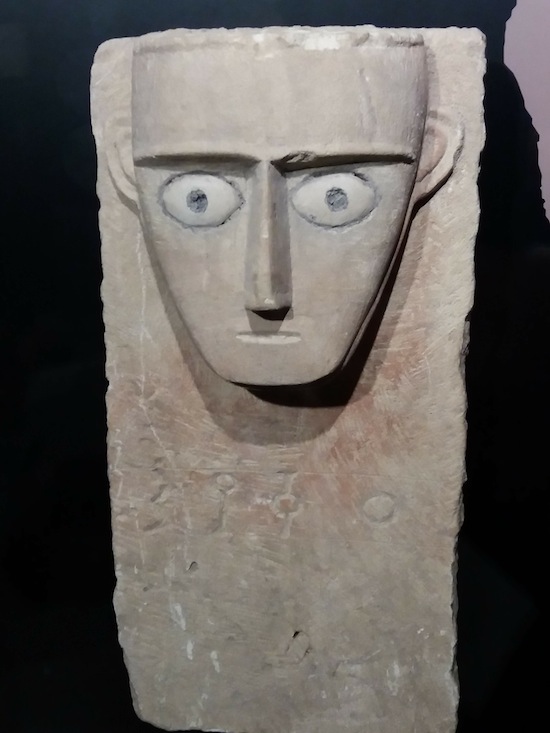
Travel Tuesday: Nabatean Funerary Stelae


A couple of weeks ago I visited Málaga in the south of Spain. Besides a couple of castles, which I blogged about here, I also saw the Ifergan Gallery, an interesting private collection of ancient art. Among the collection were these Nabatean Funerary Stelae.

The Nabatean civilization thrived from the 4th century BC until it was absorbed into the Roman Empire by Trajan in 106 AD. They lived in the Levant and Arabian Peninsula and controlled the trade routes connecting the Persian Gulf, Red Sea, and Mediterranean. Remains of several of their cities can still be found in the deserts, including the famous site of Petra in Jordan.

One feature of their art was these enigmatic stone faces. They were placed on tombs and bore the names of the deceased. Similar stones were used to depict the gods in temples, although they tended to have more realistic features.


Monday, 18 June 2018

Writing and Travel Update, Plus A Sale!

I've been a bit silent on here of late, but that doesn't mean I haven't been busy! I have two books coming out soon--both, as it happens, historical mysteries set in my favorite stomping grounds of North Africa. One is the next in the Masked Man of Cairo series, and the other is the start of a new series set in Tangier during the International Zone era. Both will be coming out in late June or early July.

There's some travel in the cards too. Next week I'm off to Málaga for four days. It's a historic port on the Costa del Sol in Spain with a couple of castles and the home of Picasso. You'll be getting some posts on that when I get back. Later in the summer I'll be back in Oxford for my usual research trip/escape from the heat of Madrid. The focus this summer will be trying to finish up a book I've been working on for a while on the writing habits of highly prolific authors. The Bodleian Library has a lot of good source material.

Also, my Tangier literary novel The Last Hotel Room is on sale as a 99 cent ebook through June 24 in the Amazon US store. Grab it if you haven't read it already!

Monday, 9 October 2017

Travel Tuesday: Traditional Sephardi Costume from Morocco


On a recent trip to Segovia near Madrid I spotted this in the local Jewish museum. It's a traditional boy's outfit from the Sephardi Jewish community in Morocco. Segovia had a thriving Jewish community until they were kicked out in 1492. Many joined their brethren in Morocco. Nowadays the Jewish community in Morocco, once about ten percent of the population, has dwindled significantly. Many left to move to the newly established state of Israel after the war and a few years later more left when Morocco became independent, fearing persecution. For more on Morocco's Jewish community, check out my post on a hidden synagogue in Tangier.

Friday, 7 July 2017

Military History Photo Friday: El Castillo de San José in Lanzarote, Canary Islands


As I mentioned on Monday, I was on vacation in Lanzarote all last week. Even though I wasn't writing, I was keeping my eye out for interesting blog post material. This week on Black Gate I blogged about the island's Piracy Museum, and next week will see another Lanzarote post as well.

And here's something for this blog, a fort called El Castillo de San José, which guarded the approach to the port of Arrecife. It was built between 1776 and 1779. The whole island is dotted with forts to protect the various harbors from pirates and rival powers such as the British.

A combination double-header outhouse and gun turret. The soldiers were apparently not shy, or just lonely.

This particular fort was actually built in a time of relative peace as a make-work project for the islanders, who were going through tough economic times thanks to a drought and a volcanic eruption that ruined the crops. Thus it earned the name Fortaleza del Hambre (Hunger Fortress).

It now houses a contemporary art museum and a cool restaurant/bar that retains its 1970s decor.

The restaurant gives a fine view of the fishing port.
The original Seventies interior is intact.
Even the stairs to the bathroom are groovy!

Monday, 3 July 2017

Back From Vacation and Back To Work


For the last eight days I've been doing something rare for me--nothing! I went on a vacation to Lanzarote in the Canary Islands to see some of my in-laws and the World's Coolest Nephew. This wasn't one of my usual research/writing trips, but an actual vacation where I didn't write for a full eight days, the longest I've gone without writing in I don't know how long. The last time I took an actual vacation was five years ago when I spent a long weekend in Wales.


It was refreshing, and now I'm back in Spain and back to work. Lots more ghostwriting, plus working on the fourth Toxic World post-apocalyptic novel, and another project I'll talk about in a later post. Lanzarote was tons of fun, but it's good to be back!

What have you been up to so far this summer?

Friday, 2 June 2017

Military History Photo Friday: Sixteenth Century Ivory Powder Horns


Sometimes even the most common objects can be turned into works of art. Here are some powder horns from the sixteenth century, intricately carved in ivory. This was the age of wheellock firearms, and these powder horns, used to hold gunpowder, would have been carried by the nobility on hunting expeditions. Common soldiers had to settle for more basic models.


I discovered these beauties at the Museo Lazaro Galdiano here in Madrid, the same place I saw that amazing roll top desk from my last post. They have a large collection of art, arms and armor, sculpture, even retro toys!

To see more of the museum's collection, check out my post on the Black Gate blog on the Museo Lazaro Galdiano.

This one seems to have been carved out of an animal leg bone. Nothing went to waste in those days!

Friday, 6 January 2017

Feliz Día de los Reyes Magos!


Today is the day of the three kings here in Spain, coinciding with Epiphany, when the three kings or wise men brought gifts in the baby Jesus. It always made more sense to me to give gifts on this day than Christmas, and that's what the Spanish do. There's also a huge meal, because no Spanish holiday goes by without a huge meal. We get a huge meal on Christmas Eve, Christmas, New Year's Eve, the night before Día de los Reyes Magos, etc. As you can imagine, I've been hitting the gym pretty hard to compensate.

This photo is from the Basilica of Sant' Apollinare Nuovo, built by the Ostrogothic King Theodoric in 504 AD. It's decorated in the early Byzantine style with lovely gold mosaics that no photo can really do justice to. Ravenna is filled with early church art and you'll be seeing plenty of it on this blog in the weeks to come.

The Three Kings are really popular here in Spain, and there's a big parade for them every year. It's interesting that there's been some changes in how they're depicted since the 6th century. Balthazar, the swarthy fellow on the left, is said to have come from Ethiopia. In this mosaic he's almost white. Until recent years he was portrayed in Spain by a guy in blackface. Thankfully now he's played by an actual African. Melchior is played by an old man and Gaspar by a young man, but in this mosaic the roles are reversed. I wonder why that happened?

¡Feliz Día de los Reyes Magos!

Friday, 22 July 2016

Busy Traveling and Writing


Hi everyone! It's been a while since I blogged. I've been really busy this month with a ghostwriting assignment that's got me writing 2,000 words of fiction a day. Add that on top of my regular work and you can see how things are for me at the moment. I've also been traveling. I just spent a wonderful week in Lanzarote in the Canary Islands with my family, meeting two great soon-to-be in-laws. Between swimming and eating, I somehow managed to get my 2,000 words a day in.

And that taught me something. If I can be on vacation and still keep up a decent word count, there's no reason I shouldn't continue that once this assignment is over. Keep an eye out for more productivity from me in the future! I'm almost done with my Apache novel, and after that I'll write book four in the Trench Raiders series, or finish Book Four in my Toxic World series. I'm not sure which order those will come in, but those are the next two in any case.

Tomorrow I'm off to Oxford for my usual summer of researching, writing, and catching up with British friends. I'll try to get back to a more regular blogging schedule in August. What are your summer plans?

This isn't me, this is our waiter who stuffed us silly with seafood.

Friday, 6 May 2016

Military History Photo Friday: Armor in the Museo Cerralbo, Madrid


This week over at Black Gate I blogged about the amazing collection at the Museo Cerralbo, Madrid. Enrique de Aguilera y Gamboa (1845-1922), 17th Marquis of Cerralbo, gathered together a vast collection of art and antiquities in his mansion in Spain's capital. He had everything from old books and Roman intaglios to ornate brass lamps and suits of armor. It's now a fun museum.

Sadly, there isn't much signage in the museum and I'm not much of an expert, so I won't be able to tell you much about these pieces. If you can identify any, please drop me a line in the comments section! Hit the link above to see the full article!

Photos copyright Sean McLachlan.

A lovely suit of samurai armor.
A German zweihander (two-handed sword), plus bits of barding (horse armor), and two types of polearm--a halberd (left) and a corseque (right)

Tuesday, 26 April 2016

Travel Tuesday: El Castillo de Aulencia, Spain


My wife works about 15 miles outside of Madrid and this castle is right next to her research institute. Spring has finally sprung here in Spain and she took this amazing photo. It the winter this castle looks completely different, dark and brooding on its bare hill.

This is the Castillo de Aulencia, which guarded the confluence of the Aulencia and Guadarrama rivers. It started as an Arab castle until it was captured by the advancing Christian armies in the 14th century. They rebuilt the castle and most of what you see today dates to the 15th century. After the Reconquista pushed the Moors further and further south, this castle became less useful, especially after the Moors were kicked out of Spain entirely in 1492. Then it was allowed to slowly decay.

It took a few hits during the Spanish Civil War when the Battle of Brunete raged around it in 1937. It had a good view of the surrounding countryside so a unit of Russian volunteers on the Republican side held it for a time. The fascists pummeled the walls with artillery fire, forcing the Russians to withdraw.

Unfortunately this castle is not open to the public. This is the closest I've ever been!

Photo courtesy Almudena Alonso-Herrero.

Tuesday, 19 April 2016

Travel Tuesday: Archaeological Museum of Cuenca, Spain

The coolest artifact in the collection, a Roman brick that a couple of people stepped on while it was still wet. You can imagine the bricklayer screaming at the clueless pedestrian as he walked on it two thousand years ago, only to have a second person do the same thing!

Last weekend we got away from Madrid and spent some time in Cuenca, an hour's train ride from the capital. I'll be writing up this historic town more thoroughly in my usual Wednesday post over at Black Gate. In the meantime, here are some photos from the city's excellent little archaeological museum.

The museum has modest collections from the Neolithic, Medieval, and Early Modern periods and some impressive items from the Iron Age and Roman times. The province of Cuenca has three major Roman towns--Ercávica, Segóbriga, and Valeria, so the Roman section was especially good.

Roman feet!

Maybe the hipsters will make this style popular again.


This little guy is an Iron Age figurine, one of many in the museum's collection.


Friday, 22 January 2016

Military History Photo Friday: Colonial Forts in Morocco


This shot shows the Casbah de la Cigogne, a 17th century Spanish fort protecting the harbor of Larache in Morocco. The coastline of Africa is studded with old colonial forts, many of which are falling into decay. This one is now a hangout for the local drug addicts. You can read more about the fort and the city it protected in a post about Larache I did for the Black Gate blog.

A view of the Casbah de la Cigogne from the seaside. Photo courtesy user Dans via Wikimedia Commons. When we were there the sun was right behind the fort so all I got was a silhouette. Timing is everything in photography!

Below is part of the 15th century Portuguese fortifications in Asilah, a notorious pirate haven on the Atlantic coast. For more on this cool spot, check out my Black Gate post on Asilah. I blog every Wednesday on Black Gate, usually on travel mixed in with the occasional book review or con report.


For more on colonial forts in Morocco and elsewhere, check out the excellent website Colonial Voyage. They have a good article on Portuguese forts in Morocco.

Tuesday, 14 July 2015

Travel Tuesday: Flying around Tenerife in the Canary Islands

Wait, who's that in the pilot's seat? Yep, yours truly is flying a plane! More specifically I'm flying a Piper Cherokee Archer II, a small four-seater, around Tenerife.

One of my wife's colleagues, an astronomer named Carlos, is a licensed pilot and loves to fly small planes. Carlos is also a licensed instructor and can fly the big passenger jets too. He's a member of the Real Aeroclub de Tenerife (Royal Flying Club of Tenerife) and offered to take us around the island. When he first said I'd be flying the plane, I made polite laughter at what I thought was a predictable joke. Once we were in the air, however, he handed over the controls to me! I flew for about 45 minutes, making ascents, descents, and simple turns.

Jump the cut for more pics!

Wednesday, 8 July 2015

Travel Tuesday: Exploring the Canary Islands

This is a Dragon tree, a native species to the Canaries.
 As I mentioned last week, I'm in Tenerife, one of the Canary Islands. My wife is doing some work with the Gran Telescopio Canarias, one of the best ground-based telescopes in the world. she also works with the Hubble Space Telescope. too bad we couldn't get the funding to go into orbit!

While she's doing smart stuff and the kid is in day camp atop a nearby mountain, I'm here in La Laguna writing. Working vacations are the only kind of vacations writers get. The change of venue has done me good, because Madrid is stifling this time of year. Not that Tenerife is much cooler. Being off the coast of Western Sahara it's part of Africa even if it is owned by Spain and filled with Spanish Colonial architecture.
Seventeenth-century private home, now a museum.
Jump the cut for more photos!

Tuesday, 30 June 2015

Travel Tuesday: Cheesy Shot of the Canary Islands


Hello from Tenerife in the Canary Islands! I'm here for the next two weeks while my wife works at the local astronomy institute. I'll be doing some writing and exploring. The Canary Islands are volcanic, and Tenerife is basically one big extinct volcano. Should be some good hiking!

The islands are Spain's most distant possession, being off the coast of Western Sahara. It has a sort of Moroccan feel to it even though the architecture is Spanish Colonial or tastelessly modern. The local cuisine uses a lot of different sauces and they absolutely love garlic. This dish is baked cheese, a bit like the Greek saganaki except they don't bring it flaming to your table. The sauces are dill, coriander, and blueberry. They were all good, although the blueberry didn't work with the cheese because it masked the flavor too much. There are also several local wines that we'll be sampling. Look for more pictures soon!

Tuesday, 26 May 2015

Travel Tuesday: Medieval Paintings in Salamanca Cathedral, Spain

Christ enthroned above the terrors of Hell.

In my last Travel Tuesday post, I shared some photos of Spanish heraldry from Salamanca. This medieval university town is filled with early art. The cathedral is full of medieval wall paintings dating to the 13th and 14th century.

Jump the cut for more photos!


Tuesday, 19 May 2015

Travel Tuesday: Old Family Crests in Salamanca, Spain


As I mentioned in my last Travel Tuesday post, I recently visited Salamanca, Spain. This historic university town is filled with old buildings from the Renaissance. Many noble families lived here and you can still see their crests on the sides of some of their palaces.

In Spanish, the term for the historical town center is casco viejo, which translates to "old helmet." There are a lot of old helmets in Salmanca!

Jump the cut for more.


Tuesday, 12 May 2015

Travel Tuesday: The Medieval University of Salamanca, Spain

The Escuelas Mayores building, Salamanca.

Last weekend my wife and I headed off to Salamanca, Spain. It's a wonderful old historic city best known for its university founded in the 13th century. Here is the facade of the university's most famous building.

Like Oxford, most of the university buildings are built around a courtyard. Jump the cut to step inside.

Looking for more from Sean McLachlan? He also hangs out on the Civil War Horror blog, where he focuses on Civil War and Wild West history.

You can also find him on his Twitter feed and Facebook page.