Showing posts with label Madrid. Show all posts

Friday, 2 June 2017

Military History Photo Friday: Sixteenth Century Ivory Powder Horns


Sometimes even the most common objects can be turned into works of art. Here are some powder horns from the sixteenth century, intricately carved in ivory. This was the age of wheellock firearms, and these powder horns, used to hold gunpowder, would have been carried by the nobility on hunting expeditions. Common soldiers had to settle for more basic models.


I discovered these beauties at the Museo Lazaro Galdiano here in Madrid, the same place I saw that amazing roll top desk from my last post. They have a large collection of art, arms and armor, sculpture, even retro toys!

To see more of the museum's collection, check out my post on the Black Gate blog on the Museo Lazaro Galdiano.

This one seems to have been carved out of an animal leg bone. Nothing went to waste in those days!

Monday, 22 May 2017

Best Rolltop Desk Ever


Spotted this at the Museo Lazaro Galdiano here in Madrid. It's a rolltop desk from the 18th century. If I ever get a bestseller I'm getting one of these as my writing desk.

Today's the last day you can get my post-apocalyptic adventure story The Scavenger for free!

Friday, 6 May 2016

Military History Photo Friday: Armor in the Museo Cerralbo, Madrid


This week over at Black Gate I blogged about the amazing collection at the Museo Cerralbo, Madrid. Enrique de Aguilera y Gamboa (1845-1922), 17th Marquis of Cerralbo, gathered together a vast collection of art and antiquities in his mansion in Spain's capital. He had everything from old books and Roman intaglios to ornate brass lamps and suits of armor. It's now a fun museum.

Sadly, there isn't much signage in the museum and I'm not much of an expert, so I won't be able to tell you much about these pieces. If you can identify any, please drop me a line in the comments section! Hit the link above to see the full article!

Photos copyright Sean McLachlan.

A lovely suit of samurai armor.
A German zweihander (two-handed sword), plus bits of barding (horse armor), and two types of polearm--a halberd (left) and a corseque (right)

Tuesday, 26 April 2016

Travel Tuesday: El Castillo de Aulencia, Spain


My wife works about 15 miles outside of Madrid and this castle is right next to her research institute. Spring has finally sprung here in Spain and she took this amazing photo. It the winter this castle looks completely different, dark and brooding on its bare hill.

This is the Castillo de Aulencia, which guarded the confluence of the Aulencia and Guadarrama rivers. It started as an Arab castle until it was captured by the advancing Christian armies in the 14th century. They rebuilt the castle and most of what you see today dates to the 15th century. After the Reconquista pushed the Moors further and further south, this castle became less useful, especially after the Moors were kicked out of Spain entirely in 1492. Then it was allowed to slowly decay.

It took a few hits during the Spanish Civil War when the Battle of Brunete raged around it in 1937. It had a good view of the surrounding countryside so a unit of Russian volunteers on the Republican side held it for a time. The fascists pummeled the walls with artillery fire, forcing the Russians to withdraw.

Unfortunately this castle is not open to the public. This is the closest I've ever been!

Photo courtesy Almudena Alonso-Herrero.

Tuesday, 8 September 2015

Travel Tuesday: Moorish Architecture in Spain

Hemispherical ceiling from Cárdenas Palace, Toledo, 15th century. This wooden lacework style was common for ceilings of this period. You can just see the heraldic shields of the Cárdenas family on the sides.

As I mentioned last week, I'll be spending October writing in Tangier, Morocco, so I'm in a Moorish state of mind. This weekend we went to the archaeological museum here in Madrid and visited the section devoted to Spain's Moorish period. The centuries when African Muslims ruled over much of Spain have had a profound effect on Spanish architecture, music, cooking, and more. Even after the Reconquista finished in 1492 and the Moors were kicked out, their influence remained. Here are a few shots from my visit. I'll have some photos from Morocco itself once I get back in November. Enjoy!

Arch for a doorway, Toledo, 15th century. The Arabic writing includes religious statements plus the more secular "Happiness and prosperity".


Decorative fragment, Toledo, 14th century.

Tile, Jaén, 15th century. Spain still produces fine Islamic style tiles. I'd decorate my house with them if I could afford it!


All photos copyright Sean McLachlan.

Friday, 21 November 2014

Military History Photo Friday: Filipino Weapons and Armor of the Nineteenth Century

The Museo Naval in Madrid has a fine collection of artifacts from Spain's Golden Age of Sail. One of hte more unusual collections is this set of Filipino weapons and armor. The Philippines were a Spanish colony for many years, and the Filipino people fought against the Spanish for their independence. The Americans inherited this war when they took the Philippines from Spain in the Spanish-American war of 1898.

Monday, 1 September 2014

Back in Madrid with a new writing challenge

Hugo Award from the 2007 Worldcon in Yokohama. They had a whole collection of old Hugos on display at this year's Worldcon in London.

Another summer in Oxford is over. The leaves were beginning to turn in England when I left two days ago, and here in Madrid it's sweltering.

I had a productive time in Oxford, researching my next book for Osprey in the Bodleian Library and making lots of new fannish friends at Worldcon. Now that I'm back in Madrid I have to get down to business. I have a ton of writing projects to finish by the end of the year, including the next installments in the Toxic World and Trench Raiders series, as well as Christmas stories for each! I also want to do a few short stories. Blogging will get more attention too.

I'm also making a commitment to myself. From now on I'm writing 2,000 words a day of fiction. I often exceed this amount, but there are days where I don't write at all. Now I'm going to discipline myself to keeping my bum in the chair and getting it done. This idea comes from the late, great Frederik Pohl, who had a similar level of commitment.

OK now, I'm off to write!

Friday, 11 July 2014

Military History Photo Friday: Roman Gladiator Mosaics

OK, this isn't strictly military history, but these guys had a shorter lifespan than most combat units! Of course they got to be stars before being gutted in front of a cheering crowd, so that's some compensation I guess.

This mosaic shows a secutor fighting a retiarius and was found at a 3rd century AD site in Rome. The secutor is named Astyanax and the word "victor" is written next to him. The retiarius Kalendio has a crossed out O next to his name, which stands for "Obiit" (death).

The next mosaic is also from 3rd century Rome and shows a fight between two murmillones, Symmachus and Maternus. Symmachus killed Maternus, but is dubbed "a fortunate man", perhaps indicating that the bookies were against him!

These images come from the newly reopened Museo Arqueológico Nacional in Madrid. You can see more mosaics in an article I wrote for Black Gate Magazine.


Friday, 27 June 2014

Military History Photo Friday: Grave of a Celtiberian Warrior

As I mentioned in my previous post, I just visited the recently remodeled Museo Arqueológico Nacional. I have a series about the museum's collections coming up on the Black Gate blog, but in the meantime here's an interesting reconstructed grave of a Celtiberian warrior.

The Celtiberians were a mix of Celtic and native Iberian cultures. This grave dates to the 3rd century BC and was found near Zaragoza. It's a cist marked by a stela and contains an iron sword with silver damascening, the remains of a baton, a spear, tweezers, and a razor. You have to look good in the afterlife! There was also a spindle whorl and a clay ball of uncertain use. A pot contained the warriors cremated remains.

Thursday, 26 June 2014

Trench Raiders is done, and other news from the world of me

This has been a big week for me. We've moved back to Madrid from Santander, and it's nice to be in a big city with a lot of cultural life again. We got to visit the newly reopened archaeological museum (more on that in tomorrow's post) and yesterday I finished the first draft of Trench Raiders, the first book in my World War one action series.
I'm also busy reading the candidates for the Hugo Award, the annual science fiction awards presented at Worldcon. The convention is in London this August and I'll be there. I'm even hosting a couple of panels! I'll have a big con report for you come August.
Oh, and my eight-year-old son has started a blog, Remote Islands and Stuff. He's obsessed with Google Maps and loves to find obscure little islands in the middle of nowhere. Strange to say, that's something I used to do with paper maps back when I was his age, although I never suggested he do it himself! Could an interest in coral atolls be genetic?

This image from Wikipedia shows the 2nd Oxfordshire and Buckinghamshire Light Infantry, the heroes of trench Raiders, busy seeing off the Prussian Guard at Ypres in 1914.

Tuesday, 5 November 2013

A weekend of writing and art in Madrid

Last weekend was a long weekend here in Spain, so we left Santander and headed down to our old stomping grounds of Madrid to see family and soak up some culture.

One big event was hooking up with my old writer's group. They'd organized a write-a-thon for the first day of National Novel Writing Month. We took over the back room of one of my favorite cafes and wrote like mad! It was very cool to sit with a room full of people all writing novels.

My wife and I also got to see some art exhibitions, something that's sadly lacking in Santander. Many of the best shows are at private galleries owned by banks. The Fundación Mapfre has two exhibitions on currently. One is called MACCHIAIOLI: Impressionistic Realism in Italy. This was a mid-nineteenth century movement that broke away from the strictures of Classical painting and paved the way for Impressionism. Here's a bunch of them enjoying themselves in true Italian style.
They were against the snobbery of the establishment and to prove their point often painted their work on the backs of cigar boxes and other found objects, like this nice landscape.

Monday, 6 June 2011

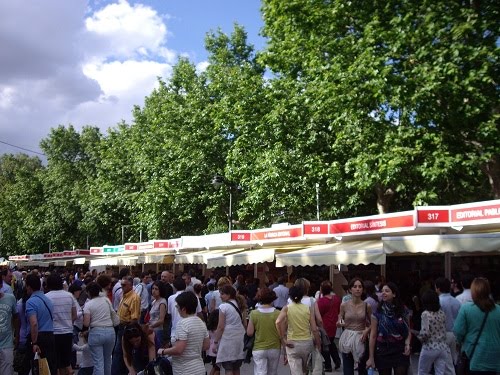
Visiting the Madrid Book Fair

This weekend I visited the Feria del Libro, Madrid's annual book fair. Last year I had a great time and so of course I went back! Sadly, my friend and successful novelist Claudia Gray didn't make it this year but hopefully I'll pass through Chicago sometime and see her.

Despite the economic crisis the book fair was packed and there were hundreds of stalls for publishers and bookstores. My son got rewarded with a bilingual story book about an alien and I picked up a few things for myself.
One publisher was selling beautiful reproductions of rare medieval manuscripts. I love these things but have never coughed up the money for one.
The comics pavilion was well attended. There was some excellent art on the walls that only the adults were looking at. The kids were busy with the free video games and candy!

I got an egoboost at two military history stands that carried my Osprey Publishing titles. Now I just have to convince my publisher to translate them into Spanish. The Medieval Handgonnes book is an obvious sell, and the American Civil War Guerrilla Tactics would probably do well too. People are interested in the American Civil War over here.
I hovered around the stall of my favorite Spanish small press, Ediciones Escalera, which has an interesting list of translated Beat Generation works and other oddities, including El Mismo Río (The Same River) an Estonian novel I picked up and am currently enjoying. I and one of the owners commiserated over the demise of Entrelíneas Librebar, my favorite literary cafe where I first discovered this publisher.

While the economic crisis may have killed a great bookshop/cafe, publishing will survive. It's a rocky road at the moment, to be sure, but people like to read. As I discussed in my series on the London Book Fair, these shows simultaneously give me hope and leave me feeling daunted. So many books, and they all have to be written by someone like me! So many books, how does one get noticed?

Friday, 3 June 2011

Photo Friday: Dusty toys behind bars

I took these shots one afternoon in Madrid's famous Rastro market, a giant flea market held every Sunday. You can buy pretty much anything there, especially if it's old, banged up, and unknown to anyone under thirty. While most of the stuff is sold from stalls, there are some permanent antique/junk shops lining the streets. This one sold toys.

I couldn't stop taking photos of the shopfront. Something about these dusty, discarded playthings behind bars touched me. I wondered about the kids who played with them and where they are now. I wonder if they remember these toys and if any of them were their favorite, or simply failed Christmas gifts of long ago.

Thursday, 5 May 2011

The Library of Forgotten Books

Shuffling between my two home bases in Oxford and Madrid last week I had a couple of hours to kill at Gatwick airport. It being past noon, I decided to spend them in the airport's pub, The Flying Horse, enjoying a last couple of pints of English real ale.

Airport pubs are soulless places, but the management at the The Flying Horse has tried to make it homey by installing big bookshelves stuffed with volumes of an age suitable for the faux country mansion decor of cheap wood paneling, dark carpet, and dim lighting.

Studying the titles I had to wonder when the last of them was read. They all seemed to be unknowns that passed into obscurity in the first month they were published. How many people really read A Girl and Her Ways by Amy Le Feuvre or Edward Henry Bickersteth by F.K. Aglianby? Did Hine's Relics of an Uncommon Attorney earn out its advance? The Six Proud Walkers almost got me with the title, but sorry F. Beedin, I prefer to hike alone.

The only familiar face in this crowd of strangers was War and Peace--in an edition old enough to be tattered but recent enough to be of no value. And it was in Russian. And only volumes three and four.

I can't decide how I feel about books being demoted to mere decoration. On the one hand, it's demeaning to the dreams of hundreds of struggling authors. They're all almost certainly dead, so I guess that's a relief. On the other hand, their only other destination would have been the rubbish skip. If books can still provide the atmosphere of refinement, don't they still have a value?

I wonder if my son will walk into an airport pub seventy years from now and see one of my own titles being used to line the walls.

Monday, 10 January 2011

Lessons learned from my first photo exhibition

As I mentioned last time, this month a local cafe is hosting my first photo exhibition, on the painted caves of Laas Geel. It's running until the end of January if you happen to pass through Madrid this month. :-)

I'd never done a solo photo exhibition before and I learned a fair amount. The night went well and I even sold a photo, but things could have gone better.

First off, the timing was bad. In early January people are often still on holiday or out of town, and most people are feeling poor after holiday spending. Not a good time to have a show. I knew this ahead of time, of course, but with my travel schedule there wasn't really any choice.

Secondly, I could have done more to promote it. I told my writers group, distributed fliers, announced it here and on my social media sites, and put an announcement on Couchsurfing. That last idea was a good one because I got to meet some interesting Couchsurfers living in Madrid! Still, I could have sent out more invites and distributed more fliers.

Lastly, the frames were those simple glass plates with clips. While they're the cheapest option and actually look pretty good, they make the photos look smaller. I should have gone with more substantial frames. The photos could probably have been a size bigger too.

Throughout the night several people asked me if I was going to make a presentation. They seemed to have expected one. Perhaps I should have done one. I'm not sure if I should have given it in Spanish or English, though. About half the crowd were native English speakers, and in a couple of cases couldn't have followed a Spanish presentation. Vice versa for the rest of the crowd. The slide show I had running all night got a lot of attention, though, and became a focus of conversation with several people.

All in all, I was happy with the evening's attendance and have learned a lot about how to do my next event.

Thanks to my wife Almudena for taking the pictures of the event! She only had the instamatic that night so I'm looking a bit scary. Another thing to remember for next time!

Tuesday, 4 January 2011

Photo Exhibition: The Prehistoric Painted Caves of Laas Geel

Regular readers of this blog will remember that I visited the unrecognized state of Somaliland last year. One of the highlights of my trip was seeing the painted caves of Laas Geel. The paintings are up to 10,000 years old and rank among the best preserved in Africa.

This beautiful but little-known site is the subject of my first solo photography exhibition. I'm having the grand opening on Saturday, January 8, at Café Béigol Bagel, Calle Meléndez Valdés, 29. Metro: Arguelles or Moncloa. Yes, it's a bagel shop. A rather humble beginning for my photography career but hey, I'm a writer first. If you happen to be in town pleased drop by. I'll be talking about the site and Somaliland in general.

For more on the caves, check out my post on Laas Geel and my series on travel in Somaliland.

Friday, 22 October 2010

I'm interviewed on "Live Your Life Well"

Andy Hayes, managing editor of the excellent travel blog Live Your Life Well, has interviewed me about my twin loves of history and travel as part of his ongoing Travel Experiences Interviews. Hop on over there to hear me blather on about ancient monuments and achieving dangerous childhood dreams. Make sure to poke around the rest of the site too for other neat articles including one on candy around the world and a very cool piece on visiting Peshawar.

So what does the above photo have to do with all of this? Well, nothing really, but it brings back good memories of traveling in Somaliland. This guy is an Oromo, an Ethiopian people, but he works in the Somaliland capital Hargeisa as a street vendor making tasty samosas. So. . .an Ethiopian cooking Indian food in Somaliland for a Canadian??? That sort of randomness is one of the things I love about travel!

Looking back on this week's posts I notice that there's been a lot of self-puffery. So let me puff someone else for a change, fellow Madrid writer Sue Burke, who just had a short story published on Daily Science Fiction called Zero Hour. Check it out. It's only 900 words so you can take a look while the boss isn't paying attention.

Tuesday, 21 September 2010

Writers are like opera singers

Last weekend I went to a housewarming party here in Madrid. One of the hostesses is a big opera fan and knows many important people in the opera community. I'd never met anyone associated with opera so it was interesting to talk with not just one but two professional opera singers and an aspiring singer.

I got into a long conversation with a woman who was on her third Madrid show and had worked in other cities as well. She isn't famous, but she's earning a living. Sort of a midlist opera singer! We compared our professions and found them to be remarkably similar. Despite having proven her worth time and again she still has to deal with getting turned down for shows, or even having her correspondence ignored. Finances are also precarious.

So don't think you're alone, struggling writers, because the singers, musicians, and painters are all in the same boat. Making it doesn't mean making it big, yet this woman loves her work and doesn't want to do anything else. I guess all the silly professions have to deal with the same troubles, and reap the same rewards.

[Photo courtesy Wikimedia Commons]

Wednesday, 23 June 2010

Travel writing ups and downs

I just got a gig doing an online guide to Madrid. It's short, less than 10,000 words, so it's a quick and easy writing job for a resident to do. The only real challenge are the hotel listings. Having an apartment, I've never needed to stay in a hotel! Plus the few times that friends have come through and not crashed at my place, the hotels they stayed at were decent but unremarkable. My readers need something special.

So yesterday I wandered around Sol, a historic downtown area popular with tourists and teeming with hotels. I had a list of ones I'd heard were good and planned to see. The first on my list was Petit Palace Arenal on Calle Arenal 16. I went to the front desk, introduced myself as a guidebook writer, and asked for some information.

The woman I spoke to gave me a surly look and said, "We're really busy. We don't have time." Then she turned her back on me. Considering that when I came in, she and her friend were busily engaged in just standing there staring into space, I had a hard time believing that. I shrugged, told her there were plenty of other hotels, and walked out.

Needless to say they aren't going in the guidebook. If a receptionist is "too busy" to help or even be polite to someone offering them free advertising, how well do they treat their guests? I've had this happen a few times when writing my Phoenix guidebook and London guidebook and it's always mystified me. The staff at the next two hotels I visited were very helpful, showed me around, and answered all my questions. Proper hospitality. One would think this would be a no-brainer!

If you're interested in getting into the crazy world of guidebook writing, check out my article on Breaking into the Guidebook Market.

Saturday, 19 June 2010

Visiting Madrid's book fair

The past two weeks have been fun for Spanish book lovers. The Feria del Libro (Book Fair) at Madrid's lovely Retiro Park brought out all of Spain's publishers and major bookstores. Many foreign publishers also showed up. I've talked before about the value of going to book fairs, especially the London Book Fair, as well as fan conventions.

I joined a couple of members of my local writer's group to browse more than 300 stalls packed with books. I discovered two military history bookshops I didn't know about and some publishers that I might try to sell translation rights to. Writers should go to these things to see what's out there. Plus it's fun to buy books! I got a couple that will help me with a book proposal of my own in the coming months.

Seeing so many books together at one time really brings home how massive of an industry publishing is. The sight is simultaneously a reassuring and depressing one. Reassuring because there's room for all types of writers, depressing because it's so easy for your title to get lost in the avalanche.

I also got to see my old friend Claudia Gray, whose YA vampire fiction is selling well in both English and Spanish. She held up remarkably well during the day despite my having kept her out until four o´clock that morning showing her Madrid's nightlife.

So come on, writers, if there's a book fair or convention near you, go to it. You won't regret it.
Looking for more from Sean McLachlan? He also hangs out on the Civil War Horror blog, where he focuses on Civil War and Wild West history.

You can also find him on his Twitter feed and Facebook page.