Showing posts with label archaeology. Show all posts

Monday, 20 May 2019

New Print Edition Available and New Release Soon to Come

The print edition of The Case of the Shifting Sarcophagus, the second in my Masked Man of Cairo historical mystery series, is out now. There was a big delay thanks to a hopeless layout company I will never hire again. Publishing is full of landmines. Now, at last, it's available.

The third in the series, The Case of the Golden Greeks, is moving forward again after a long spell of ghostwriting that will fund some trips later in the year to Morocco and Egypt. I'm also in final edits for Emergency Transmission, the fourth in my Toxic World post-apocalyptic series. That will be coming out in early June. I'll be sure to announce it here.

If you want to hear more from me, you might consider joining my Facebook page, where I make all my announcements as well as share my online writing for other sites and one or two interesting articles on archaeology or history every week.

Tuesday, 19 February 2019

Travel Tuesday: Treasures of the Egyptian Museum

Shabtis were put in tombs to act as servants in the afterlife.

As I mentioned in my previous post, I got back from Egypt last week, which means I have plenty of pictures for Travel Tuesday posts!

When I'm in Cairo I always reserve a couple of afternoons to wander around the National Museum. It's absolutely huge and no matter how many times I go there, I always see something new. A new National Museum is being constructed on the Giza Plateau near the pyramids. I passed the building the last time I went up there. It's a sleek, modern building that's even bigger than the existing museum. As with many government projects, it's behind schedule, but when it finally opens it promises to be stunning. In the meantime, we have the old museum to enjoy.

Stela of the Buchis Bull, showing one of the Ptolemaic pharaohs giving offerings to the sacred bull in their burial place in Armant. The Buchis bulls were manifestations of the god Ptah.

Two male figurines made of gold during the Late Predynastic period. Yep, these two guys are older than the oldest pharaoh!
Column of painted limestone carved to look like a lotus flower.

Sunday, 29 July 2018

The Case of the Shifting Sarcophagus Out Now!


The second book in my Masked Man of Cairo series, The Case of the Shifting Sarcophagus, is out now. It's the next adventure for Sir Augustus, Moustafa, and Faisal, who we met in The Case of the Purloined Pyramid. I'll be writing the third book in the series late this year when I go back to Egypt. A blurb is below.

An Old Kingdom coffin. A body from yesterday.
Sir Augustus Wall had seen a lot of death. From the fields of Flanders to the alleys of Cairo, he’d solved several murders and sent many men to their grave. But he’s never had a body delivered to his antiquities shop encased in a 5,000 year-old coffin.
Soon he finds himself fighting a vicious street gang bent on causing national mayhem while his assistant, Moustafa Ghani, faces his own enemies in the form of colonial powers determined to ruin him. Throughout all this runs the street urchin Faisal. Ignored as usual, dismissed as usual, he has the most important fight of all.

Available as an ebook on Amazon, Amazon UK, and all the other Amazons. Print edition coming soon!

Tuesday, 10 July 2018

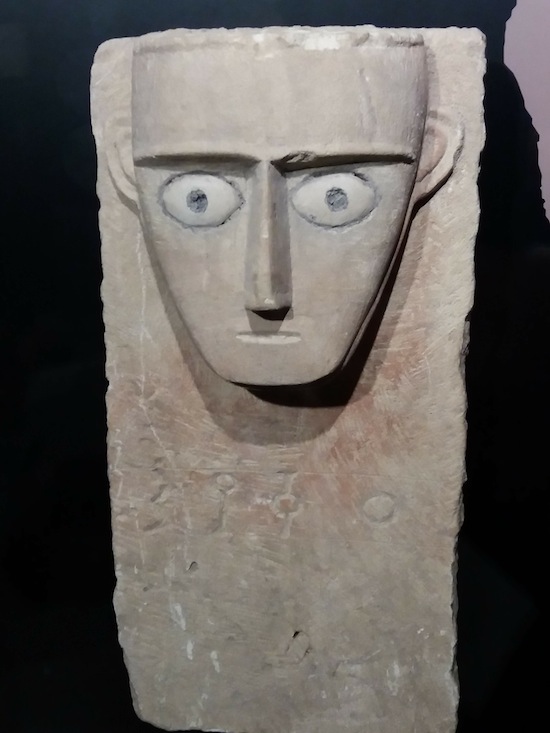
Travel Tuesday: Nabatean Funerary Stelae


A couple of weeks ago I visited Málaga in the south of Spain. Besides a couple of castles, which I blogged about here, I also saw the Ifergan Gallery, an interesting private collection of ancient art. Among the collection were these Nabatean Funerary Stelae.

The Nabatean civilization thrived from the 4th century BC until it was absorbed into the Roman Empire by Trajan in 106 AD. They lived in the Levant and Arabian Peninsula and controlled the trade routes connecting the Persian Gulf, Red Sea, and Mediterranean. Remains of several of their cities can still be found in the deserts, including the famous site of Petra in Jordan.

One feature of their art was these enigmatic stone faces. They were placed on tombs and bore the names of the deceased. Similar stones were used to depict the gods in temples, although they tended to have more realistic features.


Thursday, 8 March 2018

My Second Cairo Mystery Novel is in the Editing Stage!


The Case of the Shifting Sarcophagus, the second in my historical mystery series The Masked Man of Cairo, is now in the editing stage. I finished the rough draft a couple of days ago, finally squeezing out some time from my busy ghostwriting schedule.

The sequel to The Case of the Purloined Pyramid sees Augustus, Moustafa, and Faisal teaming up again to solve another murder. This time an Old Kingdom sarcophagus appears in Augustus' house while he is asleep. He opens it to find the former chief of Paris police dead inside! How did such a huge sarcophagus get into his house unnoticed, and why did the murderers deliver the body to Augustus? You'll find out when it's released.

If you want to know about the release of this and other books of mine, consider signing up for my newsletter. It comes out every two months or so and includes a short story, travel article, news, and a coupon for a discounted or free book.

Friday, 13 October 2017

Military History Photo Friday: Historic Forts in Saudi Arabia


When we think of Saudi Arabia, we generally don't think of castles, but a fair number dot the arid landscape of the desert kingdom. One of the most impressive is Marid Castle, pictured above. Located in the ancient city of Dumat al-Jandal in the north of the country. The city dates all the way back to at least the tenth century BC. It's unclear how old the fort is, but it existed by 272 AD. It was the site of numerous battles, most recently in 1853 and 1909. During the second attack it withstood a siege of ten months before finally falling.


Perhaps the most impressive fortification was Ajyad Fortress, an Ottoman citadel built in 1780 overlooking Mecca in order to protect the holy city from raiders. Despite the Bedouin being Muslims themselves, they weren't averse to robbing Muslim pilgrims. In a controversial move, the Saudi government demolished the historic fort in 2002 in order to build luxury a hotel for rich pilgrims. This has been part of an ongoing campaign to demolish historic sites, especially ones from the pre-Islamic period or sites that remind the Saudis of the time when they were part of the Ottoman Empire.


Many small forts were built at oases along the pilgrimage route to protect the pilgrims from bandits.  Some date to the reign of the Ottoman Sultan Suleiman the Magnificent (ruled 1520-1566), who had forts built to protect the main routes. This one at Dhat al-Hajj still stands, although in poorer condition than this photo from 1907 shows. It's a simple structure, but that would be all that would be needed to ward off the Bedouin, who lacked artillery.


A similar fort stands at Al-Ukhaydir, and was also built by Sultan Suleiman the Magnificent. This photo from 1907 shows the fort at the center and some Bedouin tents to the left.


Photos courtesy Wikimedia Commons, because that's probably the closest I'll ever get to Saudi Arabia.

Tuesday, 25 April 2017

Travel Tuesday: Ancient Egyptian Shabtis

A variety of shabtis from the 19th and 20th dynasties (1292-1075 BC)

If you've spent much time in the Egyptology section of any good museum, you've probably seen a collection of little figurines that look like miniature mummies. These are called "shabtis", meaning "answerer". They were put in tombs in order to answer the call to work in the afterlife so that the deceased could relax. They'd come to life and do whatever labor the gods called on them to do.

Some shabtis got their own coffin and larger collections were put in decorated boxes like the one on the left.

Shabtis come in a variety of styles and quality and are made of wood, faience, wax, terracotta, or stone. Some tombs had hundreds of them, and they are one of the most common artifacts to find in museums. These are from the archaeological museum in Bologna, Italy.

I recently did a blog post over on Black Gate about shabtis in the Egyptian Museum in Cairo that goes into more detail about these remarkable artifacts. I've also done a post right here on a rare double shabti.


Tuesday, 14 March 2017

Travel Tuesday: Old Kingdom Death Mask from the Museum of Egyptian Antiquities in Cairo


My recent trip to Egypt was actually the second time I visited that fascinating country. The first was way back in 1991. As I wandered around the sights, I was occasionally hit by deja vu. Other sights I remember clearly from my first visit. One of the latter is this arresting Old Kingdom death mask in the national museum in Cairo.

It stuck in my mind from my first visit because the face looks just like people you see in Egypt today. Indeed, despite Egypt being popularly perceived (and officially titled) an Arab nation, only 17% of the genetic makeup of the modern population is Arabic. A recent study by National Geographic found that the Egyptian population is genetically 68% North African, 17% Arab, 4% Jewish Diaspora, 3% East African, 3% from Asia Minor, and 3% southern European. Thus the modern Egyptian population is much the same as the ancient Egyptian population, and this 4,000 year old mask shows a face that can still be seen on the streets of Cairo today.


Friday, 10 March 2017

Back From A Writing Retreat In Egypt


I'm back from Cairo! Actually I've been back for a few days but returned to a heap of ghostwriting I needed to get done. I'm just now coming up for air.

This is my new writing buddy, the priest Padiamenopet, shown here posing as a scribe. He worked at the vast temple of Ra at Karnak in the 25th dynasty (760-656 BC). His right hand would have held a reed pen, which is now missing. You can see the scroll he's working on. I wonder what his daily word count was? Now he lives in the Egyptian Museum, which was just five minute's walk from my hotel. I ended up going there a lot! I also, of course, visited Giza, Saqqara, and Dashur. The last is the home to the famous Bent Pyramid, seen below. The last time I was in Egypt, way back in 1991, it stood inside a military base and was closed to visitors, so it was nice to finally get there.

I was very fortunate to attend the Cairo Video Festival, an experimental film festival, early in my stay. Because of this I met an interesting circle of Egyptian and Sudanese filmmakers, artists, historians, and writers who kept me busy for the rest of my trip.

Of course I was there for writing, and I got 35,000 words into a novel set in Cairo during the 1919 Revolution, an early major push for independence. Called The Masked Man of Cairo, it's a neo-pulp adventure story of a disfigured WWI veteran who, disgusted with Europe, moves to Egypt and starts a business selling antiquities. Soon he finds just as much trouble as he had during the war! More on that novel as it progresses. Our hero (more like antihero) lives in Old Cairo, a labyrinth of medieval streets and centuries-old buildings. I spent much of my time wandering this wonderful part of the city catching inspiration.

I'll be posting lots of Egyptian photos here and over on Black Gate, where I blog on Wednesdays. You can also see more pictures on my Instagram account. Stay tuned!

Wednesday, 3 August 2016

Insecure Writer's Support Group: My First Piece of Writing as an Aspiring Writer

Welcome to the Insecure Writer's Support Group, where on the first Wednesday of every month we vent our anxieties to the world. This month's topic is our first piece of writing, which wasn't all that anxiety ridden for me.

I'm not sure how to answer this topic. My first published work came when I was still an archaeologist and had no intention of becoming the full-time writer I am today. On the other hand, when I decided to make a career change way back in 2001, I started writing for a newspaper in Tucson and now I can't remember what my first article was. I suppose I could look that up, but life's too short and I have writing to do!

So I'm going with my first published work from the mid 90s, when I dove headfirst into the second wave of the zine boom. A zine, for those who came into writing after the start of the Internet age, was a self-published or communally published small magazine. Mine was called Ichthyoelectroanalgesia, which as everyone knows means using an electric fish as a pain killer. You can read more about that wonderful word on my old blog.

My zine was entirely done by myself, using clip art for illustrations. I included travel articles and articles about archaeology, and even answered reader's questions. While it only lasted four issues, Ichthyoelectroanalgesia had a distribution of well over 100, a respectable figure for a zine although some of the more successful broke 1000. It had a cover price of $2 if I remember correctly, but few of the issues were paid for since the point of zines was to trade with other zinesters.

While I intended it as a hobby, the pure fun of writing and publishing got its hooks in me, and within a few years I decided to become a writer.

Tuesday, 19 April 2016

Travel Tuesday: Archaeological Museum of Cuenca, Spain

The coolest artifact in the collection, a Roman brick that a couple of people stepped on while it was still wet. You can imagine the bricklayer screaming at the clueless pedestrian as he walked on it two thousand years ago, only to have a second person do the same thing!

Last weekend we got away from Madrid and spent some time in Cuenca, an hour's train ride from the capital. I'll be writing up this historic town more thoroughly in my usual Wednesday post over at Black Gate. In the meantime, here are some photos from the city's excellent little archaeological museum.

The museum has modest collections from the Neolithic, Medieval, and Early Modern periods and some impressive items from the Iron Age and Roman times. The province of Cuenca has three major Roman towns--Ercávica, Segóbriga, and Valeria, so the Roman section was especially good.

Roman feet!

Maybe the hipsters will make this style popular again.


This little guy is an Iron Age figurine, one of many in the museum's collection.


Tuesday, 22 December 2015

Travel Tuesday: Lixus, A Roman City in Morocco


Hello from Morocco! I'm back in one of my favorite countries for the next two weeks. I'll be staying in Tangier, as usual, and will be taking a road trip to the ancient Roman city of Lixus.

Like many Roman cities in North Africa, it was originally a Phoenician city, founded in the 7th century BC. It became a Roman city in the early 1st century AD. It's most famous for its fine Roman mosaics that I've blogged about previously and also its amphitheater.

I've been blogging a lot about Morocco over at Black Gate. You might want to check out my articles on Morocco's only stone circle, the old pirate port of Asilah, the medieval medina in Tetouan, and my experience living in a Moroccan home.

These photos are courtesy of Wikimedia Commons. My own photos will come soon!


Monday, 14 December 2015

Book Review: A History of Ancient Egypt by Nicolas Grimal

A History of Ancient EgyptA History of Ancient Egypt by Nicolas Grimal
My rating: 3 of 5 stars

You know those books that you find kind of dull but you can't put down because they're teaching you so much you want to learn? This was one of those books for me. This is a detailed history of Ancient Egypt from the Predynastic Period until the end of the Late Period. Emphasis is on royalty and their great works of architecture. While this is all fascinating, I could have used more information about regular people, the economy, technology, and all the other aspects of this complex civilization.
I could have also used prose that was less dry, maps that were more complete, and more explanation of terms to lessen confusion.
That said, I couldn't put this book down. There was so much information packed in its dense type that I was learning several things I didn't know on every page, and I have a Masters in archaeology. Granted, my focus was early medieval Europe, but I've still read a lot of Egyptology. This is not a book for the lay reader, but rather someone who has done a fair amount of reading.
If you're looking for a good intro to Ancient Egypt, this is not it. If you have some knowledge and want to learn more, try this out.

View all my reviews

Monday, 7 December 2015

Travel Tuesday: Roman Mosaics in Morocco

Venus and Adonis.
Morocco became part of the Roman Empire in 40 AD as the province of Mauretania Tingitana. There are several good archaeological sites in the country, including the famous city of Volubilis and several smaller cities such as Lixus.

In the archaeological museum of Tetouan, there are a number of fine mosaics from Lixus. Originally a Phoenician city founded in the 7th century BC, it prospered under Roman rule. The mosaics you see here were all made in the 2nd and 3rd centuries AD. Life wasn't always peaceful in Roman Mauretania Tingitana, however, as you can see from this picture of a most unfortunate Roman soldier.

For some more shots of this kind of art, check out my post on Roman gladiator mosaics.

Mars and Rhea Silvia.
The three graces.

Friday, 27 November 2015

Military History Photo Friday: Frontier Forts of the Emperor Hadrian


Photo courtesy Jean-Pierre Neri via Wikimedia Commons.

This is an aerial photo of Lambaesis, a Roman fort in what is now Algeria. It was built during the reign of Emperor Hadrian (117–138 AD). This was a permanent camp for the III Augusta legion complete with fortification walls, baths, an amphitheater, and temples.

Meanwhile, at the empire's northern frontier at the edge of Scotland, Hadrian was building the wall that would bear his name. The below photo is an aerial view of Housesteads fort, situated on the wall and the base for the II Augusta legion. While it's smaller than the contemporary fort in Algeria, you can see that its based on a very similar plan. The Romans standardized many of their buildings, only varying them because of special needs or terrain. Thus if a legionnaire decided to switch from the III to the II legion, and moved from the heat of Algeria to the damp of Scotland, he'd be able to make his way around the fort without any problem.

A few years ago I did a series about hiking Hadrian's Wall on the now-defunct travel blog Gadling. The photo galleries are gone but all my text is still up.

The photo of Housesteads is courtesy the Tynedale U3A. Hadrian's Wall Group, which is doing great work educating the public about Hadrian's Wall.


Tuesday, 25 August 2015

Travel Tuesday: Protodynastic Egyptian Bracelet in the Petrie Museum


Can you tell I like the Petrie Museum? I blogged about this place for earlier posts on Midlist Writer about slings and other ancient Egyptian artifacts. I also did a post with lots of photos for Black Gate.

This is a bracelet from the Protodynatic Period, also called Naqada III, a time from c. 3200-3000 BC when states were beginning to form but the country had not yet been unified. The first hieroglyphs also date from this time, as do some rich cemeteries.

Someone should start making replicas of this bracelet, because my wife would love one. I think the original is out of my price range!

Friday, 7 August 2015

Military History Photo Friday: Ancient Egyptian Sling


As I mentioned in my last Travel Tuesday post, I recently visited the Petrie Museum of Egyptian Archaeology in London. It's absolutely chock full of great artifacts and doesn't have the crowds of the much better-known British Museum.

Here you can see a sling that may have been used for hunting or war. The dirty one is the original , alongside a reproduction and the loom on which the repro was made. In the right hands, a sling was a deadly weapons. Soldiers didn't wear much armor beyond a shield in those days, and so were vulnerable to a stone flying at them at high speed. I made myself a sling when I was a boy and while I never got very accurate with it, I could throw with a dangerous amount of force. Imagine what an ancient soldier could have done!

For a bunch more Egyptology pics, check out my article on the museum at Black Gate.

Tuesday, 4 August 2015

Travel Tuesday: Egyptian Treasures in the Petrie Museum, London

A painted stele showing a man named Ihefy adoring the god Horus and offering him a lotus, Dynasty XXII-XXV (1991-1550 BC)

I'm back in Oxford, so as usual one of the first things I did was head down to London to see friends and museums! Last week I visited the Petrie Museum of Egyptian Archaeology at University College London. I'll be writing about it in more detail over at the Black Gate blog tomorrow, so tune in there for more info and pictures.

There isn't much information on the label, but the Paser mentioned here may have been the Viceroy of Kush (now Sudan) during the reign of the Pharaoh Ay (c.1323–1319 BC) and perhaps one or two later rulers.
I've always been drawn to simple objects from the past, such as this ancient spoon. Whose was it? What was their favorite meal?


All photos copyright Sean McLachlan.

Friday, 26 June 2015

Military History Photo Friday: An Assyrian Chariot from the National Museum of Iraq


This bas-relief shows an Assyrian chariot, c. 9th century BC. The king stands in all his splendor, relaxing under a parasol as he runs over an enemy. His soldiers have gathered a pile of heads for his inspection. Yeah, the Middle East has been a rough place for quite some time now.

If we are to judge from Assyrian art, the chariot was an important arm of their powerful war machine. Chariots could move quickly, with a driver steering while an archer fired from the back. The chariots could be used to break up enemy formations before the Assyrian infantry moved in, as well as for scouting missions and running down fleeing soldiers. The Assyrians had one of the most organized and technologically advanced armies of the time, with elaborate siege machines, a disciplined and professional force, and quality weapons. It's no wonder they were both feared and hated.

I took this shot in the National Museum of Iraq when I was in Baghdad in 2012. Yeah, I'm still nattering on about that trip. I haven't gotten to travel much in the past year so I miss being on the road! Hopefully 2016 will be a better travel year. I've also blogged about the museum for Black Gate, with plenty more photos.

Friday, 29 May 2015

Military History Photo Friday: Fakhr-al-Din al-Maani Castle, Palmyra, Syria

Fakhr-al-Din al-Maani Castle, photo courtesy the Institute for the Study of the Ancient World.

This imposing castle is called the Qalat ibn Maan and overlooks the ancient city of Palmyra in Syria. I visited way back in 1994 and just wrote about my experiences for Black Gate, reflecting on what's going to happen to the site now that ISIS has taken it over.

I have clear memories of this castle. As you can see from the top photo, there's a steep climb to get up there. I remember huffing and puffing in the desert sun to make it to the base of the wall, only to spot the other side, which you can see in the below photo. There was a road leading right up to it I could have walked on and saved myself the trouble!

As it was, I was stuck on a narrow ledge running around the base of the wall. As I inched my way around, a Syrian family strolling up the road gave me a friendly wave.

After making a fool of myself, I thoroughly enjoyed exploring the castle and mounting one of the towers for a sweeping view of the oasis, the ancient site, and the surrounding desert. The castle was built around 1230 to protect this important caravan stop between Mesopotamia and the Mediterranean. Nowadays Palmyria is still strategically important. It was the scene of fierce fighting over the last few years between government forces and rebels, and just a couple of weeks ago ISIS swept in from the east and took it over. Reports indicate the castle has been battered by RPG, artillery, and small arms fire.

It's still standing, though, and now bears scars from another tumultuous era of the history of the Middle East.

Another view of the castle, courtesy Jerzy Strzelecki via Wikimedia Commons.

Looking for more from Sean McLachlan? He also hangs out on the Civil War Horror blog, where he focuses on Civil War and Wild West history.

You can also find him on his Twitter feed and Facebook page.