Showing posts with label Rome. Show all posts

Friday, 16 March 2018

Military History Photo Friday: The L3/35 Tankette


I was digging through some old photos the other day and came across this one of yours truly at a military museum in Rome. I'm standing beside an Italian L3/35 tankette. Tankettes were a popular idea for some nations in the Interwar period. As the name implies, they were miniature tanks, smaller and faster than the behemoths of the First World War.

The L3/35 was first mass produced in 1936 and measured 3.17 x 1.4 x 1.3 m (10.4 × 4.59 × 4.27 ft). It had a top speed of 42 km/h (26 mph), weighed 3.2 tons, and had a crew of two--a driver and gunner. Armament was a pair of machine guns. At its thickest, the armor was only 12 mm (.47 inches).
The tankette served in the Italian invasion of Abyssinia (Ethiopia) and large numbers of them were sent to help the fascists during the Spanish Civil War. Their thin armor made them vulnerable, and having the guns fixed to the front meant the tankette had to be turned to bring the weapons to bear. Abyssinian warriors would rush up behind the tank and stuck their swords into the tracks, which was often enough to disable them! In the Spanish Civil War they had to face tanks sent to the Republican army by the Soviet Union like the BT-5 and T-26. These were real tanks with cannons and turrets and everything. You can guess how well the little Italian models fared.

By World War Two, the L3/35 was obsolete, but that didn't stop the Italians from fielding large numbers of them in North Africa. The British made short work of them. It's amazing any survived to end up in this museum!

Friday, 21 April 2017

Military History Photo Friday: Roman Crocodile Armor


Yes, it's been almost a month since I posted. Sorry about that! I was on a research trip to Oxford and London, plus I was slammed with a ghostwriting deadline. Hopefully I'm now back on track for more regular blog posts.

I spotted this lovely suit of armor in the British Museum. It's from Manfalout, Egypt, from the 3rd or 4th century AD. This town is in Middle Egypt where there were many sacred grottoes to the crocodile-headed god Sobek, god of the Nile. These grottoes had sacred crocodiles that were often mummified after death. Roman soldiers often took on local religions and the troops in Manfalout were no exception. They would hold religious processions in honor of Sobek while wearing crocodile armor.

Photo copyright Sean McLachlan. Sorry for the reflection in the middle of the shot. I twisted and turned every which way and this was the best I could get. They really needed to invent artifact cases that don't reflect at all!

Friday, 27 November 2015

Military History Photo Friday: Frontier Forts of the Emperor Hadrian


Photo courtesy Jean-Pierre Neri via Wikimedia Commons.

This is an aerial photo of Lambaesis, a Roman fort in what is now Algeria. It was built during the reign of Emperor Hadrian (117–138 AD). This was a permanent camp for the III Augusta legion complete with fortification walls, baths, an amphitheater, and temples.

Meanwhile, at the empire's northern frontier at the edge of Scotland, Hadrian was building the wall that would bear his name. The below photo is an aerial view of Housesteads fort, situated on the wall and the base for the II Augusta legion. While it's smaller than the contemporary fort in Algeria, you can see that its based on a very similar plan. The Romans standardized many of their buildings, only varying them because of special needs or terrain. Thus if a legionnaire decided to switch from the III to the II legion, and moved from the heat of Algeria to the damp of Scotland, he'd be able to make his way around the fort without any problem.

A few years ago I did a series about hiking Hadrian's Wall on the now-defunct travel blog Gadling. The photo galleries are gone but all my text is still up.

The photo of Housesteads is courtesy the Tynedale U3A. Hadrian's Wall Group, which is doing great work educating the public about Hadrian's Wall.


Saturday, 16 February 2013

Book Review: Pagan City and Christian Capital

Pagan City and Christian Capital: Rome in the 4th CenturyPagan City and Christian Capital: Rome in the 4th Century by John Curran
My rating: 4 of 5 stars

This academic tome is an in-depth look at Rome's architectural and social development in the fourth century AD, a time when paganism was waning and Christianity became the dominant religion.

The first half looks at how the imperial capital, replete with symbols of paganism, slowly transformed into a place of churches and the tombs of martyrs. The second half is social history, looking at the development of the aristocracy of the time and at changing attitudes towards the Roman circus.

There are surprises throughout. While more simplistic books often describe the fourth century as a time of conflict between paganism and Christianity, the reality Curran reveals was much more complex. Christians and pagans lived and worked side by side, and except for some notable examples of persecution, pagans kept most of their religious rights for much of this century.

One of the most interesting chapters was on how Christian aristocrats discouraged individuals of their class from becoming Christian ascetics. (It was all about inheritance and continuing the family line, you see). Another interesting passage studies how the pagan symbols in the Circus Maximus remained in full public view long after most temples were closed, yet gradually lost their pagan meaning to be replaced with a more general one. The statues of Victory, for example, stopped being statues of a goddess and became symbols of the idea of victory.

I found the reading a bit dense at times and the author assumes way too much knowledge. I have a Masters in archaeology (although not Classical archaeology) but didn't know all the terms Curran expected me to. Also, he quotes extensively from French, Latin, and Greek sources without translating them. The French I can do, the Latin kinda sorta, and the Greek, well. . .it's all Greek to me!

I think Curran made a serious mistake here. With a bit of extra work, he could attract a much larger readership of educated laymen rather than a tiny audience of fellow academics. Considering the interesting subject matter and the depth of work that went into this book, that's a pity.

View all my reviews

Friday, 14 January 2011

Photo Friday: Roman ruins and modern sprawl in Mérida, Spain

Welcome to Photo Friday. This week we have a shot I took on the outskirts of Mérida, in Spain's autonomous community of Extremadura. It's a Roman aqueduct on the edge of town, not far from the ancient hippodrome. I like the contrast between ancient and modern here, with the car whizzing by on the highway and a modern house right next door.

I just wrapped up a travel series for Gadling about this region, titled Exploring Extremadura: Spain's historic southwest. Hop on over to see more pictures!

Saturday, 18 September 2010

Words of wisdom from an old writer

As I mentioned before during Rome Week here on Midlist Writer, Italian military historian Piero Crociani was a huge help during my research trip. He's written numerous books on the uniforms of the Italian army and the various states that existed before unification and is considered one of the foremost authorities on the subject.

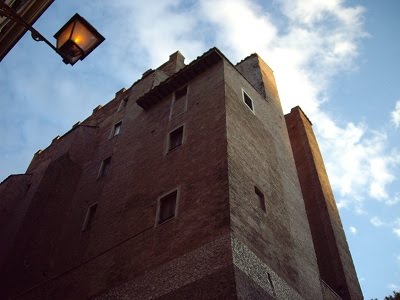
He's also an authority on Rome, and I was lucky to be able to tap into his font of knowledge. For example, this strange building near the Colosseum caught my eye. It has a medieval look but had obviously been turned into apartments at one time before becoming derelict. Now it's under restoration. I mentioned the building to Crociani and he told me it was a medieval tower owned by one of the many rich families of Rome, who often had bloody power struggles with one another. A few decades ago it was home to a society of military collectors. How appropriate!
Here's another view of the same building.

Piero was interested to hear of my writing. When I told him about the many different subjects write about he laughed and said, "You are wasting your life in the best possible way!" An odd compliment but I'll take it as it was intended. :-)

He laughed again when I told him on the last day of my trip that I hadn't gotten to do much sightseeing. "I've spent so much time in photo archives I haven't had much time for me."

He laughed and put a hand on my shoulder.

"Be honest, Sean! That time was for you too. Be honest!"

Well hey, it's true. I do like a good archive.
And I did get to do some sightseeing, including visits to lesser-known spots like the Arch of Janus shown here. Built in the fourth century either under the Emperor Constantine or his son Constantius II, it actually never was dedicated to Janus. That's a later embellishment. Like the tower above, it served as part of a family fortress during the Middle Ages.

Janus makes an appropriate symbol for my trip to Rome. The god of portals, gateways, and beginnings and endings is a perfect summary of any writer's career. With his two faces he looks back at past accomplishments and mistakes, and looks forward to the future. I'm looking back with pleasant memories at my time in Rome, and looking forward to visiting again!

Friday, 17 September 2010

Advantages of being a midlist author

The best thing about being a midlister is you get to write about a wide variety of subjects. These different jobs often support one another. For example, I was in Rome last week research a military history book for Osprey Publishing and at the same time wrote a travel series for Gadling. I didn't have a huge amount of time for sightseeing so I decided to focus on a single subject. The result is Vacation with the Dead: Exploring Rome's Sinister Side. I'm covering things like the Purgatory Museum, Renaissance tombs of Rome, and military museums in Rome. Upcoming posts will be on saints' relics, Christian catacombs, mummified monks, and more! My editor made a cool pinbox that I've added to the sidebar here.

Another advantage of writing about many different things is that you get into interesting conversations with all sorts of people. Staying at my hotel in Rome were two young Italian guys who looked like soldiers. I asked them if they were in the army and they said yes.

"What part of the army?" I asked.

"Army, yes," they answered in halting English, not understanding the question.

"No, I mean, Alpini, Bersaglieri, Caribinari?"

Their eyes lit up. Not only did this foreigner know something about the Italian army, but he actually gave a damn! Almost instantly a bottle of fine Sardinian lager was pressed into my hands and much drinking and conversation ensued. It turned out they're members of the Alpini, Italy's elite mountain infantry. We talked about their duties and Italian military history, like the grueling battles of Isonzo fought high in the Alps during World War One. They also talked about their frustration at not being able to serve in Afghanistan. You have to be in the army three years before you can apply to go. Imagine, these guys actually want to go to Afghanistan! I hope they get a chance to kick some Taliban butt.

That's what being a writer can do. Would these two guys, half my age and barely speaking my language, have gone on a bender with me if my research hadn't given us some common ground? It just goes to show you never know who you're going to meet in the business of writing.
[Top photo courtesy Eurocopter, bottom courtesy Italian Army, both via Wikimedia Commons]

Wednesday, 15 September 2010

Writing a book on Rome?

How can a writer not be inspired by Rome? Here's yours truly in a proud moment. I'm standing at one of the entrances to St. John Lateran, leaning against the giant bronze doors that once led into the Roman Senate. They were moved here in the 17th century to grace this massive church.

This poorly framed photo taken by some Italian kid reveals one of my original historical interests--the transition from pagan to Christian in the period of Late Antiquity. How did an empire that embraced a variety of gods and showed toleration to any religion that toed the line turn into a monotheistic force that changed the direction of faith forever? I covered this in my first solo book, Byzantium: An Illustrated History, and I'd like to get back into the subject.
Rome is a good place to study this because so many buildings from that period remain. Here's Santa Maria Maggiore, a fourth century Roman basilica converted into a church at a time when Christianity had only become the state religion within living memory. Some of the mosaics date back to 440! This was the first sight I saw in Rome and my biggest thrill. I've seen plenty of Roman sights, even hiked Hadrian's Wall, but all the ruins I had seen had been just that--ruins. Now I was actually standing inside a Roman building!
Not far away is Santa Pudenziana, with this beautiful fourth century apse mosaic. Within a century the Romans had gone from sacrificing to Jupiter, Mithras, and the emperor, to building churches.

This period is often overlooked in tours and guidebooks, and I'm thinking of doing a history/guidebook that would tell the story of the city's transformation from pagan stronghold to Christian capital. I'd tell it in straight historical narrative, but anytime a sight in Rome fits into the story, I'll switch into guidebook mode. Thus the visitor could follow the struggle between paganism and Christianity through Rome's buildings, while the armchair traveler could simply read it as a history book.

I've done a bit of research and I haven't seen any book that does exactly what I'm proposing. I'll have to look more before making a pitch to an editor and agent, though. There's a lot of books about Rome out there!

Tuesday, 14 September 2010

Historical research in Rome

This dapper fellow is an Italian colonial soldier from the 1880s. He's on display at the Museo Storico della Fanteria, the Infantry Museum in Rome. This is what the Italian troops wore as they established a colony in what is now Eritrea. The uniform was a little different in 1896 when they got their butts kicked by the Ethiopians at the battle of Adwa (or Adowa, or Adua, depending on what language you're writing in).
Here's an ascari, a native soldier working for Italy. Some were Eritrean, but many were Sudanese, especially the artillerymen. The Italians didn't want to teach anyone in Ethiopia or Eritrea how to use cannons, but they learned just the same. This uniform dates from the early part of the twentieth century. One problem with historical research is that it's hard to find exactly what you need.
But I did find this! Here's an Italian cannon captured by the Ethiopians at Adwa and recaptured in 1935 or 1936 when Mussolini's troops successfully invaded Ethiopia. I found this thanks to two fellow writers at Osprey Publishing, Pier Paolo Battistelli and Piero Crociani. These Italian scholars were hugely helpful in cutting through red tape, tracking down photos, and showing me around Rome. Piero took me to the Infantry Museum, where the curator knows him, and I was ushered into a room where this treasure stood. The curator decided the light wasn't good enough and we got to push it out into the main hall!

Lifting up the back portion I found it to be quite well balanced and could easily roll it along the smooth marble, so easily in fact that the curator let go and I jogged away down the hall with his cannon! Of course lugging this thing across the rough terrain of the Ethiopian highlands is another matter.
Here's Piero posing in front of more cannons from Adwa, set in the museum garden underneath a Roman arch. As you can see they're quite small, but good enough to fight infantry or the poorly constructed African fortifications. To give an idea of scale, Piero is about 5'8''.

We had a great time wandering around the museum, and I commented to Piero, "I can't believe that twenty minutes ago I was touching the ancient door of the Roman senate and now I'm wheeling a nineteenth century cannon down the hall."

Piero simply shrugged and said, "This is Rome."

Monday, 13 September 2010

Writing Inspiration in Rome

I just got back from a week in Rome, and as you can see it was beautiful. I went to research photos for a book I'm doing on the Adowa campaign for Osprey Publishing. This 1896 confrontation between Italian colonial forces and the Ethiopians led to a disastrous defeat for the Italians and continuing independence for Ethiopia. While I spent much of my time in archives, I did see some of the sights.

And what sights! How couldn't a writer be inspired by Rome? Here, for example, is the arch of the Emperor Septimius Severus (ruled 193-211 AD). Set up in the Forum, it commemorates his victories over the Parthians and Arabs.
The above scene shows the Roman army attacking the city of Seleucia on the Tigris River in what is now Iraq. Yeah, there's always been trouble in that part of the world.
Here are a pair of winged Victories over the arch. The arch originally had statues on top of Severus in a chariot flanked by his sons Caracalla and Geta, both of whom later became emperors. I was very proud that I could identify this arch and puzzle out most of the inscription without resorting to my guidebook. All that archaeological training has paid off!

The trip was very productive. I got the rest of the photos I needed for the Adowa book, material for a series I'll write for Gadling, and plenty of extra material I'll be posting here all this week. So join me every day for Rome Week here at Midlist Writer!

Saturday, 4 September 2010

From Oxford to Rome

I've just enjoyed my last day in Oxford. We come up here every summer for research and it's always a great time. I mean, just look at this photo. This is where I work when I'm in town. Now I'm exchanging the Dreaming Spires for the Eternal City, the Isis for the Tiber. That's right, I'm headed for Rome!

I'll be in Rome next week to do some research on the Adowa campaign, Italy's failed attempt to subjugate Ethiopia in 1896. Earlier this year I went on a trip to Ethiopia to do some on-site research. Now I'm going to get the Italian side of the story by digging into their military archives. A couple of Italian historians will be meeting me to offer advice and show me around a bit.

This is the first time I've been to Italy, making this the third new country I've visited this year after Ethiopia and Somaliland. I won't have too much time for sightseeing although I'm planning a short series for Gadling. Actually I find not having much time rather liberating. It frees me from seeing all the things "I have to see" and allows me to see whatever the hell I want!

Anyway, I may be a bit sporadic for the next few days. When I get back I'll be sure to treat you to good photos and anecdotes. Ciao!

Tuesday, 1 July 2008

Guest Article: My Virtual Book Tour

If you've been reading my blog for a while, you'll recognize Angela K. Nickerson, who passed through here a while back during her virtual book tour. The VBT has become a handy tool for promoting an author's work, and today she shares her experiences.

My first book, A Journey into Michelangelo’s Rome (Roaring Forties Press: 2008), hit bookstores without fanfare, hurrah, or splash. In fact, though my local Borders said it had one copy in stock, I never had that pleasure of standing in front of it to admire it. They lost it in the stockroom. Needless to say, my publishing house, like so many out there, produces lovely travel books on a very low budget leaving little room for publicity.

So, like many Midlisters, I have been doing most of my own publicity work, and I have learned a great deal along the way. And because I am not a trust fund baby with millions to burn, I have had to do it all on the cheap. Thank heavens for the Virtual Book Tour!

In September, 2007 the New York Times ran an article profiling Amy Cohen and her blog book tour. I happened to be in the last editing throes on Michelangelo’s Rome at that point, and I read the article knowing that my publicity reality would be similar. Ms. Cohen’s publisher, Hyperion, set up her blog tour, but it was clear that I would have to do my own. So, once the manuscript was put to bed, I started researching. Those long months between sending the book off to the printer and seeing it in my hands for the first time were filled with internet searches and hours and hours of reading.

The idea of a virtual book tour (VBT) is relatively new, and there are several people claiming to have invented the idea, but it really all boils down to one thing: an author blogs for different sites in an effort to drive interest and sales. That sounds pretty simple, but in reality it is much more complicated.

First, I developed a list of blogs and sites to target. In fact, I broke that list down into three groups. I decided that I would have three weeklong mini-tours—one in April, one in May, and the final in June. I targeted different kinds of sites in each month hoping to build some momentum from week to week.

Once I had my list developed, I enlisted some help. One of the sites I hoped to target had some very specific advice for authors: have a publicist do the asking. This site indicated that it would not even consider requests from authors themselves. Fortunately I have a friend who was willing to do a little PR work for me for free, so I took her up on her offer. I supplied her with the list of sites to approach and the accompanying materials, she sent the emails and helped me create a schedule.

One of the critical elements of a VBT is exclusivity: each day should be devoted to only one site. And then you must send readers to that particular site. A VBT, when done right, is mutually beneficial. You reach new readers at each new stop, but ideally you direct readers from your own blog or other writing venues to their sites, too, thus boosting their readership. I kept a schedule at my own website and updated my blog each day with links and teasers sending my readers to the sites where I was appearing. I am also a Red Room author, so I kept my blog and calendar at Red Room updated as well.

Having something different and original to say at each stop is also important so that readers will follow you from one site to the next. The easy thing to do is to deliver the same answer every time the question arises, “How did you get into travel writing?” And while the answer is essentially the same, I tried to vary the response as much as possible.

In the end my VBT has been a lot of work, but it has been totally worth it! I’ve been a guest blogger on so many great sites (20-some in all), and I’ve been able to write posts about a wide range of topics. High Culture on a Low Budget asked me to create a playlist for A Journey into Michelangelo's Rome which you can now buy on iTunes. I did a Micro Travel-Writing Workshop for the readers at Nerd’s Eye View. Europe a la Carte in England invited me to do a live chat. And I did several interviews including with the Traveling Mamas (who also did a book giveaway), Blissful Travel, and Write to Travel (out of New Zealand).

I don’t have the budget to go leave the continent to promote the book. And my in-person appearances are all self-funded, so this is a cheap way to connect with readers all over the world. And while I love to meet my readers face-to-face, I’ve had some wonderful opportunities to interact in different and exciting ways while making my way around the blogosphere.

Many thanks to all of you—including Midlist Writer—who have hosted me on my VBT. Rest assured: I am excited to return the favor!

Tuesday, 10 June 2008

Writing Success Story: Angela Nickerson Combines Art and Guidebook Writing

The guidebook industry is changing. A lot of travelers carry a general guidebook and one that's more specialized in region or subject. This new niche for travel writing is being explored by Roaring Forties Press in their new ArtPlace series, which looks at a city or region through the works of its greatest artist.

One of their titles is A Journey into Michelangelo's Rome, written by first-time author Angela K. Nickerson. Today, Nickerson talks with us about her writing success.

"Greetings, fellow Midlisters! Sean has graciously asked me to regale you with the story of my modest beginnings as a Midlist writer, and I am happy to oblige.

"My literary life began modestly. When I was a student, I loved to write. And I truly loved research. I also loved to travel, a passion ignited early (I blogged about my first European trip here). However, I really didn’t translate that into a career path. In my mind writers worked at newspapers or wrote fiction or poetry. I knew that I didn’t have the news bug. I was not prepared to be a starving novelist (kudos to you guys!). And there are even fewer jobs for poets. So, I became a teacher – and my students did a lot of research!

"However, teaching others to write just didn’t satisfy my own desire to write. I found myself doing more and more journaling and fantasizing about 'becoming' a writer. In reality I already was. I was writing all the time. I just wasn’t earning any money doing it.

"Over the course of a few years I transitioned out of the physical classroom (though I still teach writing privately) and started with small, local publications. I ended up with a column in a monthly magazine as well as several other publications that regularly featured my work…and then I got a book deal.

"I came upon a call for proposals. Roaring Forties Press had begun a new series of books, the ArtPlace books, and they were looking for writers. Immediately I knew that Michelangelo and Rome (both of which I know very well) would be the perfect fit. I wrote the book proposal, and it took about a year to hammer out the details and sign a contract. But now, three years later, the book is on the shelves!

"My journey has been a very slow one. And I am impatient to support myself completely as a writer. That is coming, but I do still have a 'day job.' My goal is to be able to write full time within a few more years, but it is more likely that we will be able to live on my husband’s income than on what I make as a writer (remember: I don’t really want to be a starving novelist).
"The untold story, though, is that once a midlist book is out, the REAL work begins. In the middle of the pack, money for promoting the book itself is scarce. So, those of us without reviews in the New York Times and banners in the windows at Borders are faced with a lot to do if we want our returns to be low and our precious work to stay off the remainders table.

"I am now engaged in full-time promotion of my book (in addition to my 'day job'). It is exhausting and gratifying and exciting and exasperating all at once. I am blogging (Just Go!) and guest blogging, writing articles, keeping my website current, doing readings and giving talks… and I love it! After all, I love Rome. I love Michelangelo. And the teacher in me can talk or write about both all day long.
"But the next book is also percolating, and I miss the solitude of research and writing and the complete immersion in another place and time. It is just about time to get back to the library again…"

I'll be posting a review of
A Journey into Michelangelo's Rome along with some of Angela's stunning photographs, on my other blog, Grizzled Old Traveler, on June 12. Also, don't forget to check out Angela's website.
Looking for more from Sean McLachlan? He also hangs out on the Civil War Horror blog, where he focuses on Civil War and Wild West history.

You can also find him on his Twitter feed and Facebook page.