Showing posts with label museum. Show all posts

Tuesday, 10 July 2018

Travel Tuesday: Nabatean Funerary Stelae


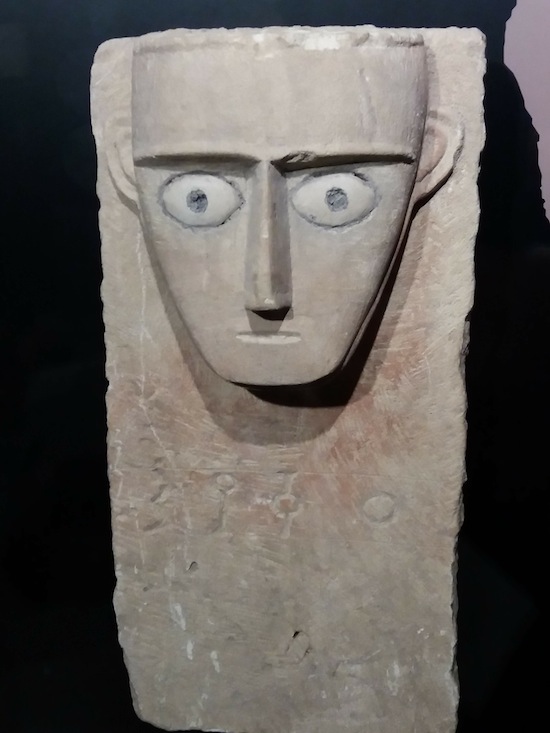
A couple of weeks ago I visited Málaga in the south of Spain. Besides a couple of castles, which I blogged about here, I also saw the Ifergan Gallery, an interesting private collection of ancient art. Among the collection were these Nabatean Funerary Stelae.

The Nabatean civilization thrived from the 4th century BC until it was absorbed into the Roman Empire by Trajan in 106 AD. They lived in the Levant and Arabian Peninsula and controlled the trade routes connecting the Persian Gulf, Red Sea, and Mediterranean. Remains of several of their cities can still be found in the deserts, including the famous site of Petra in Jordan.

One feature of their art was these enigmatic stone faces. They were placed on tombs and bore the names of the deceased. Similar stones were used to depict the gods in temples, although they tended to have more realistic features.


Friday, 16 March 2018

Military History Photo Friday: The L3/35 Tankette


I was digging through some old photos the other day and came across this one of yours truly at a military museum in Rome. I'm standing beside an Italian L3/35 tankette. Tankettes were a popular idea for some nations in the Interwar period. As the name implies, they were miniature tanks, smaller and faster than the behemoths of the First World War.

The L3/35 was first mass produced in 1936 and measured 3.17 x 1.4 x 1.3 m (10.4 × 4.59 × 4.27 ft). It had a top speed of 42 km/h (26 mph), weighed 3.2 tons, and had a crew of two--a driver and gunner. Armament was a pair of machine guns. At its thickest, the armor was only 12 mm (.47 inches).
The tankette served in the Italian invasion of Abyssinia (Ethiopia) and large numbers of them were sent to help the fascists during the Spanish Civil War. Their thin armor made them vulnerable, and having the guns fixed to the front meant the tankette had to be turned to bring the weapons to bear. Abyssinian warriors would rush up behind the tank and stuck their swords into the tracks, which was often enough to disable them! In the Spanish Civil War they had to face tanks sent to the Republican army by the Soviet Union like the BT-5 and T-26. These were real tanks with cannons and turrets and everything. You can guess how well the little Italian models fared.

By World War Two, the L3/35 was obsolete, but that didn't stop the Italians from fielding large numbers of them in North Africa. The British made short work of them. It's amazing any survived to end up in this museum!

Friday, 18 August 2017

Military History Photo Friday: World War One Medals and Mementoes


Hello from Oxford! I'm here for my usual research trip, and as a matter of fact this is my tenth year. It's been a rainy summer so I haven't gotten to explore much of the countryside like I usually do. Luckily last weekend the clouds cleared and my family and I went on a hike to visit Minster Lovell, a fine old ruin of a medieval manor. Follow the link for an article I did on it.

We set out from the small town of Whitney, which has a fine little local history museum. Here are a couple of shots from the World War One section. I've always enjoyed small-town museums since the collection comes from old neighbors instead of some rich patron. I wonder who donated these?


Friday, 2 June 2017

Military History Photo Friday: Sixteenth Century Ivory Powder Horns


Sometimes even the most common objects can be turned into works of art. Here are some powder horns from the sixteenth century, intricately carved in ivory. This was the age of wheellock firearms, and these powder horns, used to hold gunpowder, would have been carried by the nobility on hunting expeditions. Common soldiers had to settle for more basic models.


I discovered these beauties at the Museo Lazaro Galdiano here in Madrid, the same place I saw that amazing roll top desk from my last post. They have a large collection of art, arms and armor, sculpture, even retro toys!

To see more of the museum's collection, check out my post on the Black Gate blog on the Museo Lazaro Galdiano.

This one seems to have been carved out of an animal leg bone. Nothing went to waste in those days!

Friday, 5 May 2017

Military History Photo Friday: Traditional African Weapons

A collection of Kpinga, a type of throwing knife used by the Azande people of southern Egypt and northern Sudan. They were equipped with various blades to increase the risk of cutting when thrown. They were high status items, only used by elite warriors (it must have taken some training to throw one accurately!) and were also given as part of the bride price when a man wanted to get married.

Last week I blogged about an interesting collection of African shields at the Ethnological Museum in Cairo. It's one of many attractions in that wonderful city that I got to visit while writing my next novel, The Masked Man of Cairo, which I'm happy to say is almost done.

Besides the shields, the museum also has a collection of African weapons, mostly, I believe, from the Sudan and captured during the Anglo-Sudan War, when the British fought the Mahdi from 1896-99. Like with the shields, I'm hardly an expert, so any help identifying these objects would be highly appreciated.

All photos copyright Sean McLachlan. Sorry about the quality of some of them. The display cases are in desperate need of a good cleaning!

Various knives and cleavers.

The sign says "sticks used by drummers" but they look like clubs to me, and are in the weapons room, after all.

A variety of spears. The broad-leafed blades are typical of those carried by the Mahdi's army.
The top broadsword was a typical type used by the Mahdi's men. The sword on the bottom has a sheath made of crocodile skin. What better way to show off your manliness?

Looking for more from Sean McLachlan? He also hangs out on the Civil War Horror blog, where he focuses on Civil War and Wild West history.

You can also find him on his Twitter feed and Facebook page.