Showing posts with label history. Show all posts

Thursday, 20 June 2019

It's the 50th Anniversary of the Moon Landing! Here Are Ten Reasons the Conspiracy Theorists are Stupid


We're coming up on the 50th anniversary of the Moon landings. Sadly, there are some people who think we never went to the Moon. While I have a healthy mistrust of government, I find this conspiracy theory silly to say the least. Governments lie on a regular basis, especially the U.S. government, but that doesn't mean they lie all the time. Here are ten reasons that this conspiracy theory, peddled by people who want to make a quick buck off of public credulity, is total bullshit.

1. The testimony of thousands of people involved in the project.

2. The fact that none of them in the past 50 years have blown the lid on the "conspiracy", despite the potential to get millions for their story.

3. The hundreds of professional and amateur astronomers worldwide who saw the reflected light of the Apollo spacecraft through their telescopes, and the countless people they showed this wonder to.

4. The fact that the Soviet Union, despite its extensive spy network and a very big motive, never called the U.S. on the "lie."

5. The fact that no other nation hostile to the U.S. has done this in 50 years.

6. The hundreds of pounds of Moon rocks divided up and sent to researchers in dozens of countries, including Russia. Moon rocks are unlike any rocks found here on Earth. Where did the conspirators get them?

7. The fact that actually going to the Moon is not a great technological feat for an already space-faring nation, merely an economic challenge, and we're talking about the richest country in the world here.


8. A NASA satellite has photographed the Moon landing site from space. Of course they're part of the conspiracy, but are Japan and India?
http://www.squidoo.com/apollo-moon-landing-photos-from-space

9. The weak arguments in support of the "hoax" has been debunked in several venues. Here's one of the best.
http://www.xmission.com/~jwindley/

10. Given all the above reasons, it would be easier just to go to the Moon!


Photo of Charles Conrad Jr., Apollo 12 Commander, courtesy of NASA. This photo is not faked. People really can achieve amazing things when they try hard enough.

Monday, 20 May 2019

New Print Edition Available and New Release Soon to Come

The print edition of The Case of the Shifting Sarcophagus, the second in my Masked Man of Cairo historical mystery series, is out now. There was a big delay thanks to a hopeless layout company I will never hire again. Publishing is full of landmines. Now, at last, it's available.

The third in the series, The Case of the Golden Greeks, is moving forward again after a long spell of ghostwriting that will fund some trips later in the year to Morocco and Egypt. I'm also in final edits for Emergency Transmission, the fourth in my Toxic World post-apocalyptic series. That will be coming out in early June. I'll be sure to announce it here.

If you want to hear more from me, you might consider joining my Facebook page, where I make all my announcements as well as share my online writing for other sites and one or two interesting articles on archaeology or history every week.

Tuesday, 4 December 2018

Travel Tuesday: A Medieval Synagogue in Córdoba, Spain

The entrance to the synagogue. The gallery above the entrance was reserved for women, who were kept out of sight of the men praying downstairs.

I just got back from Córdoba, a fascinating medieval town in southern Spain that was the capital of Islamic Spain for many years and remained important in the Middle Ages and Renaissance. A hallmark of the city during its Islamic rule was the large Jewish community, which got kicked out in 1492 when King Ferdinand and Queen Isabella expelled all the Jews and Muslims after completing the Reconquista.

Luckily a synagogue built in 1315, at the high point of Andalusian Jewish culture, has been remarkably preserved. Its decoration was common for Spanish synagogues of the time, incorporating complex plaster work in the Islamic style. After 1492, the building was used as a hospital and later a shoemaker's guild. At some point the plaster work was covered over, hiding it but also preserving it. In 1884, as the building fell into decay, some of this later mortar work fell away and the earlier decoration revealed. The synagogue was declared a national monument a year later.

The decoration is similar to a synagogue in Tangier I visited a couple of years ago. Click the link for more about that.

 
A closeup of the arch. Note the cross that was added later.


Sunday, 11 November 2018

The End of World War One


A hundred years ago today at 11:11 am, one of the most destructive wars in the history of the world finally ended. World War One led to the fall of several governments, destroyed large swathes of Europe, and killed millions of people. Not just confined to Europe, battles were fought in the Middle East, the Far East, and Africa.

The signing of the Armistice led to wild celebrations in the victorious countries, and a huge sigh of relief in the defeated ones. German civilians were close to starvation thanks to the Allied blockade, and had long since become sick of the war. Little did they know that less than 30 years later they would be in for worse.

This photo, courtesy of Wikimedia Commons, shows The Black Watch celebrating in their camp. As you can see, they are mired in mud, and the photo itself is battered and faded. I think it makes a fitting image for this post.

As regular readers of my blog know, I've been writing a series of action novels set in the Great War called Trench Raiders. I'll be coming out with book four, Under the Front, in the coming year. It will deal with the tunnelers' war, those brave men on both sides who endured unthinkable conditions to tunnel underneath enemy lines. The heroes of Company E are sent in to help, and poor Crawford, the bravest of the brave, discovers a phobia he didn't know he had.

So take a moment today to think about what our forefathers had to endure in those tough times.

May they never come again.

Tuesday, 10 July 2018

Travel Tuesday: Nabatean Funerary Stelae


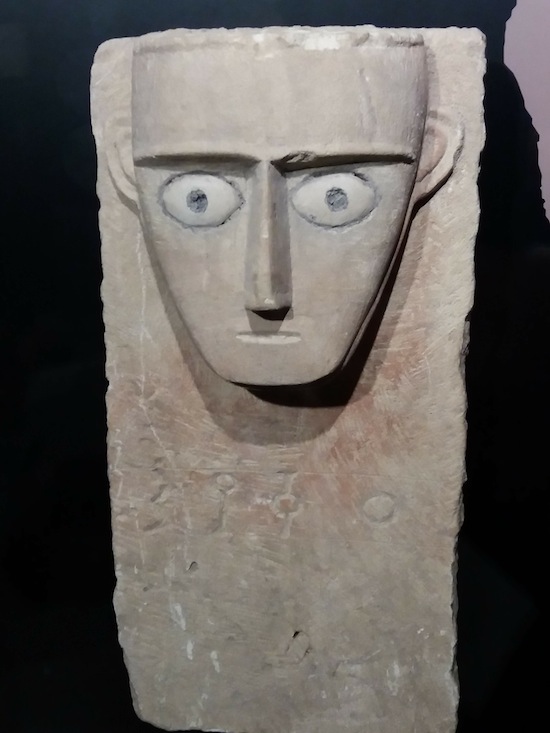
A couple of weeks ago I visited Málaga in the south of Spain. Besides a couple of castles, which I blogged about here, I also saw the Ifergan Gallery, an interesting private collection of ancient art. Among the collection were these Nabatean Funerary Stelae.

The Nabatean civilization thrived from the 4th century BC until it was absorbed into the Roman Empire by Trajan in 106 AD. They lived in the Levant and Arabian Peninsula and controlled the trade routes connecting the Persian Gulf, Red Sea, and Mediterranean. Remains of several of their cities can still be found in the deserts, including the famous site of Petra in Jordan.

One feature of their art was these enigmatic stone faces. They were placed on tombs and bore the names of the deceased. Similar stones were used to depict the gods in temples, although they tended to have more realistic features.


Thursday, 24 May 2018

Back from Tangier and Working on a New Mystery


As I mentioned in my last post, I went to Tangier for ten days to work on a novella, which has now morphed into a short novel. I got 27,000 words done while I was there but the weather was too beautiful and my friends too friendly for me to get the entire thing done. Then I came home to two big ghostwriting deadlines. Oh well.
The first draft of the book, tentatively called Tangier Bank Heist, is almost complete. It takes place during the days of the Tangier International Zone, when from 1924–1956 Tangier was run by several different European nations plus the United States. My gumshoe is a veteran of the Lincoln Brigade of the Spanish Civil War and he now lives in Tangier solving crimes and trying to help the poor. He gets his biggest case yet when his girlfriend loses her savings when the bank she put her money in gets stolen. No, not robbed, stolen. The book is based on a true story, and a bizarre story it is.
Watch for it soon!

Friday, 27 October 2017

Military History Photo Friday: The Volkshandgranate 45, A Grenade Made Out Of Concrete:


I've been reading Antony Beevor's excellent history book Berlin: The Downfall 1945 as part of my research for my Volkssturm novel. The Volkssturm were a German civilian militia formed in October 1944 in a last desperate bid to stop the Allied advance. The Volkssturm called up all able-bodied men aged 16 to 60 who weren’t already in uniform. It also called up some women.

A passing mention in Beevor's book told me of a weapon I didn't know about--the Volkshandgranate 45, or the "people's hand grenade 1945". This crude grenade was developed in the last months of the war and was the product of a chronic shortage of raw material. By this time most of the Third Reich's industrial base had been taken by the Russians, and the Germans resorted to making hand grenades out of concrete. These would be filled with bits of scrap metal, gravel, and nuggets of cement. The whole thing was fitted with a fuse and some explosive. Beevor says the Volkshandgranate 45 was more dangerous to the user than the target, and yet hundreds of thousands of them were produced in the last months of the war and distributed to the Volkssturm, Wehrmacht, and even some elite SS units.

It just goes to show how desperate the Third Reich had become in the last months of its existence. As the Nobel Prize winning author Heinrich Böll, who was drafted in to the army during the war, put it, the men were fighting not for their country, but for survival, and their only hope was that they would somehow survive after they were defeated.

Friday, 13 October 2017

Military History Photo Friday: Historic Forts in Saudi Arabia


When we think of Saudi Arabia, we generally don't think of castles, but a fair number dot the arid landscape of the desert kingdom. One of the most impressive is Marid Castle, pictured above. Located in the ancient city of Dumat al-Jandal in the north of the country. The city dates all the way back to at least the tenth century BC. It's unclear how old the fort is, but it existed by 272 AD. It was the site of numerous battles, most recently in 1853 and 1909. During the second attack it withstood a siege of ten months before finally falling.


Perhaps the most impressive fortification was Ajyad Fortress, an Ottoman citadel built in 1780 overlooking Mecca in order to protect the holy city from raiders. Despite the Bedouin being Muslims themselves, they weren't averse to robbing Muslim pilgrims. In a controversial move, the Saudi government demolished the historic fort in 2002 in order to build luxury a hotel for rich pilgrims. This has been part of an ongoing campaign to demolish historic sites, especially ones from the pre-Islamic period or sites that remind the Saudis of the time when they were part of the Ottoman Empire.


Many small forts were built at oases along the pilgrimage route to protect the pilgrims from bandits.  Some date to the reign of the Ottoman Sultan Suleiman the Magnificent (ruled 1520-1566), who had forts built to protect the main routes. This one at Dhat al-Hajj still stands, although in poorer condition than this photo from 1907 shows. It's a simple structure, but that would be all that would be needed to ward off the Bedouin, who lacked artillery.


A similar fort stands at Al-Ukhaydir, and was also built by Sultan Suleiman the Magnificent. This photo from 1907 shows the fort at the center and some Bedouin tents to the left.


Photos courtesy Wikimedia Commons, because that's probably the closest I'll ever get to Saudi Arabia.

Saturday, 29 July 2017

Free Summer Reading: A Western from the Apache Point of View


My Western novel, Warpath into Sonora is free through Monday. A blurb is below:

Arizona 1846
Nantan, a young Apache warrior, is building a name for himself by leading raids against Mexican ranches to impress his war chief, and the chief’s lovely daughter.
But there is one thing he and all other Apaches fear—a ruthless band of Mexican scalp hunters who slaughter entire villages.
Nantan and his friends have sworn to fight back, but they are inexperienced, and led by a war chief driven mad with a thirst for revenge. Can they track their tribe’s worst enemy into unknown territory and defeat them?

You can get it on Amazon, Amazon UK, and all the other Amazons. Enjoy!

Friday, 7 July 2017

Military History Photo Friday: El Castillo de San José in Lanzarote, Canary Islands


As I mentioned on Monday, I was on vacation in Lanzarote all last week. Even though I wasn't writing, I was keeping my eye out for interesting blog post material. This week on Black Gate I blogged about the island's Piracy Museum, and next week will see another Lanzarote post as well.

And here's something for this blog, a fort called El Castillo de San José, which guarded the approach to the port of Arrecife. It was built between 1776 and 1779. The whole island is dotted with forts to protect the various harbors from pirates and rival powers such as the British.

A combination double-header outhouse and gun turret. The soldiers were apparently not shy, or just lonely.

This particular fort was actually built in a time of relative peace as a make-work project for the islanders, who were going through tough economic times thanks to a drought and a volcanic eruption that ruined the crops. Thus it earned the name Fortaleza del Hambre (Hunger Fortress).

It now houses a contemporary art museum and a cool restaurant/bar that retains its 1970s decor.

The restaurant gives a fine view of the fishing port.
The original Seventies interior is intact.
Even the stairs to the bathroom are groovy!

Friday, 2 June 2017

Military History Photo Friday: Sixteenth Century Ivory Powder Horns


Sometimes even the most common objects can be turned into works of art. Here are some powder horns from the sixteenth century, intricately carved in ivory. This was the age of wheellock firearms, and these powder horns, used to hold gunpowder, would have been carried by the nobility on hunting expeditions. Common soldiers had to settle for more basic models.


I discovered these beauties at the Museo Lazaro Galdiano here in Madrid, the same place I saw that amazing roll top desk from my last post. They have a large collection of art, arms and armor, sculpture, even retro toys!

To see more of the museum's collection, check out my post on the Black Gate blog on the Museo Lazaro Galdiano.

This one seems to have been carved out of an animal leg bone. Nothing went to waste in those days!

Friday, 5 May 2017

Military History Photo Friday: Traditional African Weapons

A collection of Kpinga, a type of throwing knife used by the Azande people of southern Egypt and northern Sudan. They were equipped with various blades to increase the risk of cutting when thrown. They were high status items, only used by elite warriors (it must have taken some training to throw one accurately!) and were also given as part of the bride price when a man wanted to get married.

Last week I blogged about an interesting collection of African shields at the Ethnological Museum in Cairo. It's one of many attractions in that wonderful city that I got to visit while writing my next novel, The Masked Man of Cairo, which I'm happy to say is almost done.

Besides the shields, the museum also has a collection of African weapons, mostly, I believe, from the Sudan and captured during the Anglo-Sudan War, when the British fought the Mahdi from 1896-99. Like with the shields, I'm hardly an expert, so any help identifying these objects would be highly appreciated.

All photos copyright Sean McLachlan. Sorry about the quality of some of them. The display cases are in desperate need of a good cleaning!

Various knives and cleavers.

The sign says "sticks used by drummers" but they look like clubs to me, and are in the weapons room, after all.

A variety of spears. The broad-leafed blades are typical of those carried by the Mahdi's army.
The top broadsword was a typical type used by the Mahdi's men. The sword on the bottom has a sheath made of crocodile skin. What better way to show off your manliness?

Friday, 28 April 2017

Military History Photo Friday: African Shields

A variety of shields. The small round ones in the center are Ethiopian. One on the left has decorated brass fittings. The one next to it is made of hippopotamus hide. I believe the other shields are from the Sudan and Kenya, but I'm not sure. That skinny one on the lower left is a Dinka shield. The Dinka are from south Sudan and their shields only covered the hand, with the rod being used to parry blows. The shield on the right just above the elephant tusk is made of a turtle shell.


One of the more unusual museums I visited on my recent trip to Cairo was the Ethnological Museum. This is a very old-school museum with displays that don't look like they've been changed much in the past fifty years. It contains a good collection of costume, day-to-day objects, and weapons and armor. This includes an impressive array of East African shields that I'm showing here. In the upper floor is the Ethnographic Society with a lovely Victorian lecture hall and a sizeable library.

Located just off Tahrir Square, the heart of the famous 2011 revolution, it's one of the best guarded museums I have ever seen. Part of the grounds have been converted into a police headquarters. To get onto the property I had to go through a metal detector and show my passport. Then a cop with a machine gun escorted me to the museum. From there a museum official followed me from room to room until I left. No one is stealing these shields!

I'm far from an expert on African shields, although I am familiar with the Ethiopian forms. Unfortunately there was no signage in this room to help me. My identifications should thus be taken with a grain of salt. Any help identifying these fascinating pieces of African militaria would be highly appreciated!


The top shield is made of the plastron (belly part of the shell) of a giant turtle.
Two more shields. Like the vast majority of the shields in this collection, they are made of animal hide, which was strong enough to counter blows from clubs, arrows, and spears, but useless against bullets.
Two Ethiopian style shields. They may actually be from Sudan as this shield type was used there as well. They may, in fact, have been captured during the Anglo-Sudan War, when the British fought the Mahdi from 1896-99. Several weapons in the collection certainly come from the Mahdist army. I'll be showing those in a later post.

Thursday, 12 January 2017

Military History Photo Friday: A Walking Stick Gun


I spotted this interesting weapon in the Medieval Museum in Bologna last month. It dates from the 18th century. As you can see, if combines a flintlock musket with a gentleman's walking stick. The perfect thing for a relaxing stroll!

Italy was a lot of fun. I'm writing a series of articles about it every Wednesday for Black Gate. I've already posted on the medieval towers of Bologna, and the Etruscan treasures in the city's archaeological museum. Another post will follow this coming Wednesday!

Wednesday, 9 November 2016

Voting follows old patterns in Missouri (again!)

Four years ago, on the day after the election, I wrote the following post about the breakdown of voting in Missouri. While the name Obama has been replaced with Clinton and I had to change the percentage of the popular vote, otherwise everything remains true.

In the weeks running up to the election I became obsessed with CNN's Election Center. With all the results in, I took a look at voting in Missouri. CNN posted an interesting map showing how Missouri voted county by county.

As you can see, Clinton only carried three counties. They were St. Louis, Jackson, and Boone. She also carried St. Louis city. St. Louis County is part of the metro area, Jackson is home to Kansas City, and Boone is home to Columbia, which serves as the setting for my Civil War novel.

Knowing Missouri, I never expected Clinton to win there. She did pretty well, though. St. Louis and Jackson are, of course, the most populous counties, and Boone is number 7, so while Clinton only managed to carry three counties and St. Louis city, she did get 38% of the popular vote.

What's interesting is that St. Louis, Kansas City, and Columbia were the three main strongholds for Union sentiment during the Civil War. More rural areas (called "Outstate" by Missourans) tended to be for the South. They supported the Democrats, who back then were a conservative party that wanted to preserve the status quo. If you wanted to find supporters of the liberal alternative to the Democrats, the Republicans Party, you had to look in St. Louis, Kansas City, and Columbia.

A sweeping generalization, I know, but one that still has a ring of truth 150 years later. The three cities are still liberal and the rest of the state is still conservative, all they've done is switch parties! 

Thursday, 27 October 2016

Book Review: Islamic Art by David Talbot Rice

Islamic ArtIslamic Art by David Talbot Rice
My rating: 3 of 5 stars

This is a classic and much-reprinted primer on the highlights of Islamic art. I got the 1975 revised Thames & Hudson edition for free at a library giveaway (yippee!) so this is the edition I'm reviewing. I found the text clear and wide ranging. While it didn't go into as much detail as I would have liked, this is meant as a short introduction to a huge subject and does that quite well. I've studied Islamic art in a casual way for 25 years now and I still learned a lot from the text.

My main complaint is that the illustrations aren't up to par. Most are in somewhat grainy black and white and don't do these magnificent works of art justice. Even some of the images of illustrated manuscripts are in black and white. There are several color plates in this book but they are not of terribly good quality. I recommend this book for anyone looking to learn more about one of the world's great art traditions, but suggest that you look for a later, better illustrated edition.

View all my reviews

Friday, 21 October 2016

Old West Photo Friday: Exterminating the Buffalo to Exterminate the Indian


You've probably seen the above image. It shows a mountain of buffalo skulls and was taken c. 1870 on the Great Plains. It brings to graphic reality the slaughter and near extinction of a species that once blackened the plains in herds numbering tens of thousands.

What's often not mentioned in the history books is that the slaughter of the buffalo was encouraged by the U.S. Army. Commanders of the undermanned frontier garrisons, facing a tough war with the Plains tribes who were fighting to keep their land, realized that the tribes relied on the buffalo for food and clothing. Wiping out the buffalo, they reasoned, would bring the Indians to their knees.

During the 1870s and 80s, the army encouraged buffalo hunters to kill as many buffalo as possible. While Plains tribes would only kill a few and use all the meat and hide, white hunters would often only take the choice cuts like the tongue and leave the rest to rot. They would sometimes hold competitions to see who could kill the most and not even take any meat at all. Army bases generously supplied them with bullets and powder, and allowed their own men leave to go hunting. They would also look the other way when hunters jumped the border onto lands that were supposedly for Indians only.

As William Tecumseh Sherman, who for part of this time was overall commander of the U.S. Army, said, "If I could learn that every buffalo in the northern herd were killed I would be glad. The destruction of this herd would do more to keep the Indians quiet than anything else that could happen, except the death of the Indians. Since the destruction of the southern herd. . .the Indians in that section have given us no trouble." 

Below is an early postcard showing two buffalo hunters outside their sod house with their grisly trophies. The caption says what the Army thought this massive hunt signified: "The beginning of better things."

The Plains tribes had a different point of view. As Sitting Bull said, "A cold wind blew across the prairie when the last buffalo fell--a death-wind for my people."


Images courtesy Wikimedia Commons

Thursday, 1 September 2016

Old West Photo Friday: A Dusty Day at Fort Defiance


In celebration of my two new Native American books, here's a photo of old Fort Defiance, Arizona, from 1873. This fort was established in 1851 to defeat the Navajo, who had been resisting white expansion into their land. Like most forts in the Old West, it didn't have walls since Native Americans almost never attacked large settlements, especially military ones, as they could not afford the losses this would incur.

It looks like dusty, miserable place, but for the soldiers it was home. It seems they're having a visit from some local Navajo. By 1873, most of the Navajo were at peace with the Americans. I've zoomed in on some of the figures below.

Photo courtesy Library of Congress.


Monday, 29 August 2016

My Latest Military History Book Has Just Been Released!


Osprey Publishing has just released the seventh book I've written for them. Apache Warrior vs US Cavalryman: 1846-86 is the latest in their Combat series, which gives a soldier's eye view from both sides of a conflict. It was nice to get back to my old stomping grounds of the American Southwest, where I lived for many years. A blurb is below. You can see all my Osprey titles here.

From the 1840s onward, United States military forces clashed with the Apache, a group of Native Americans associated with North America's southwestern region. U.S. territorial expansion and conflict--first with Mexico and then during the Civil War--led to an escalation of hostilities that culminated in the defeat of the Apache leader Geronimo in 1886, although fighting continued into the twentieth century. In this study, the clashes at Cieneguilla (1854), First Adobe Walls (1864), and Cibecue Creek (1881) are assessed in detail.

Fully illustrated and featuring contemporary accounts and specially commissioned artwork, this history examines exactly how the Apache were able to pose such a grave threat to U.S. forces and how their initial advantages were gradually negated by the cavalry. Examining the tactics, equipment, and training available to each side over four decades of evolving conflict, this is an eye-opening combatant's-eye view of one of history's most intriguing campaigns.

Tuesday, 23 August 2016

Book Review: US Infantryman vs German Infantryman: European Theater of Operations 1944

US Infantryman vs German Infantryman: European Theater of Operations 1944US Infantryman vs German Infantryman: European Theater of Operations 1944 by Steven J. Zaloga
My rating: 4 of 5 stars

Full disclosure: I have written seven books for Osprey Publishing so I can't really be called an unbiased reviewer. On the other hand, I don't know the author or artist and WW2 is a bit out of my specialty. I read this as research for a novel I'm ghostwriting for a client.
This is part of Osprey's Combat series, a grunt's eye view of the fight between two opposing sides. Each book looks at the training, equipment, and motivation of a regular soldier on both sides of the battle, with three small-scale fights to illustrate what their experience was like.
I found the detail in this book quite good, and especially appreciated the information on radio communications, something that many authors overlook. The text gives the reader a brief but detailed look at how units were trained, organized, and deployed. The three combat situations were well chosen and clearly illustrate the German army's deteriorating situation in the last half of 1944, as well as the US Army's steep learning curve.
The art is up to Osprey's usual high standard and the maps were clear and easy to read.
My only quibbles were that the text was a bit dry at times and that we never get a good description of a pole charge, even though it is mentioned as an important weapon for taking out German bunkers. Of course I can imagine what a pole charge was, but a photo and some specs would seem appropriate here, especially considering the detailed coverage other weapons get.
All in all, a solid addition to the Combat series.

View all my reviews
Looking for more from Sean McLachlan? He also hangs out on the Civil War Horror blog, where he focuses on Civil War and Wild West history.

You can also find him on his Twitter feed and Facebook page.