Showing posts with label WWI. Show all posts

Tuesday, 21 January 2020

Trench Raiders on sale for 99 cents!


As I mentioned in my last post, I will be getting back into my Trench Raiders series of WWI action novels later in the year. I've been away for that series for too long and I've had readers pestering me to continue, so I will. In celebration of that, and for the release of the movie 1917. I'm putting the first Trench Raiders book at 99 cents until the end of the month. You can get it on Amazon, Barnes & Noble, and anywhere else ebooks are sold. A blurb is below.

September 1914: The British Expeditionary Force has the Germans on the run, or so they think.

After a month of bitter fighting, the British are battered, exhausted, and down to half their strength, yet they’ve helped save Paris and are pushing toward Berlin. Then the retreating Germans decide to make a stand. Holding a steep slope beside the River Aisne, the entrenched Germans mow down the advancing British with machine gun fire. Soon the British dig in too, and it looks like the war might grind down into deadly stalemate.

Searching through No-Man’s Land in the darkness, Private Timothy Crawford of the Oxfordshire and Buckinghamshire Light Infantry finds a chink in the German armor. But can this lowly private, who spends as much time in the battalion guardhouse as he does on the parade ground, convince his commanding officer to risk everything for a chance to break through?

Friday, 13 July 2018

July Sale: Two Ebooks for 99 Cents Each!

You folks deserve some cheap summer reading, so until the end of July, I'm slashing the price of two of my novels to only 99 cents each. Radio Hope and Trench Raiders have both been around since 2014 and they've sold steadily, but in the past year they've been eclipsed by some of my more recent efforts. So this is a chance to rediscover some of my earlier writing. While both are the start of series, they can be read as standalones.

Radio Hope is the first of the Toxic World series, which has three books and a spin-off novella. Book Four is coming out in the autumn. A blurb is below.

In a world shattered by war, pollution and disease. . .
A gunslinging mother longs to find a safe refuge for her son.
A frustrated revolutionary delivers water to villagers living on a toxic waste dump.
The assistant mayor of humanity's last city hopes he will never have to take command.
One thing gives them the promise of a better future--Radio Hope, a mysterious station that broadcasts vital information about surviving in a blighted world. But when a mad prophet and his army of fanatics march out of the wildlands on a crusade to purify the land with blood and fire, all three will find their lives intertwining, and changing forever.

Radio Hope is available on Amazon, Amazon UK, and all the other Amazons. Enjoy and please spread the word!


Trench Raiders is the first in the Trench Raiders series of World War one action novels, which includes three novels and a novella. Here's the blurb:

September 1914: The British Expeditionary Force has the Germans on the run, or so they think.
After a month of bitter fighting, the British are battered, exhausted, and down to half their strength, yet they’ve helped save Paris and are pushing toward Berlin. Then the retreating Germans decide to make a stand. Holding a steep slope beside the River Aisne, the entrenched Germans mow down the advancing British with machine gun fire. Soon the British dig in too, and it looks like the war might grind down into deadly stalemate.
Searching through No-Man’s Land in the darkness, Private Timothy Crawford of the Oxfordshire and Buckinghamshire Light Infantry finds a chink in the German armor. But can this lowly private, who spends as much time in the battalion guardhouse as he does on the parade ground, convince his commanding officer to risk everything for a chance to break through?
Trench Raiders is the first in a new series of World War One action novels that will follow the brave men of the British Expeditionary Force through the major battles of the First World War a hundred years after they happened. The Battle of the Aisne was the start of trench warfare on the Western Front, and it was there that the British and Germans first honed their skills at a new, vicious brand of fighting.


Trench Raiders is available at Amazon, Smashwords, and within a few days will be available at all other online outlets. 

Friday, 18 August 2017

Military History Photo Friday: World War One Medals and Mementoes


Hello from Oxford! I'm here for my usual research trip, and as a matter of fact this is my tenth year. It's been a rainy summer so I haven't gotten to explore much of the countryside like I usually do. Luckily last weekend the clouds cleared and my family and I went on a hike to visit Minster Lovell, a fine old ruin of a medieval manor. Follow the link for an article I did on it.

We set out from the small town of Whitney, which has a fine little local history museum. Here are a couple of shots from the World War One section. I've always enjoyed small-town museums since the collection comes from old neighbors instead of some rich patron. I wonder who donated these?


Friday, 21 July 2017

Military History Photo Friday: The Screw Picket, A Simple Yet Brilliant Invention of World War One


In war, sometimes it's the little details that make the difference between life and death. In the early part of the war, when both sides started sneaking into No Man's Land at night to string barbed wire to protect their trenches, the Allies couldn't figure out how the Germans were doing it so quietly. The British and French wiring parties would often attract unwanted attention while hammering in the pickets to hold the barbed wire. Although they used padded mallets and put more padding on the tops of the pickets, they couldn't help but make some noise, and the alert Germans would hear it, send up a flare, and spot them. You can imagine what happened next.

Then, on 15 August 1915, the Indian Corps discovered the secret. The Germans used a different type of picket to suspend barbed wire. Called a "screw picket", it had a corkscrew on the bottom and an eye at the top through which to stick a bayonet or entrenching tool. Then all the soldier had to do was twist and screw the picket into the soil. This was much quieter than hammering, and once the Allies learned the trick they saved many lives.

The above photo, courtesy Wikimedia Commons, shows a British wiring party moving forward. Since it's daytime, this is either staged or in a rear area. You can clearly see the corkscrew on the bottom and the eye on the top.

Tuesday, 20 December 2016

Free Christmas book!

Back from three weeks in Morocco! More on that later. In the meantime, I wanted to mention that I'm having a giveaway on a Christmas book. It's called Christmas Truce and is about the famous truce on the Western Front during World War One. It's part of my Trench Raiders series but can be read independently.

You can get it for free at Smashwords, B&N, Kobo, the iStore and various other online vendors. It's at 99 cents on Amazon because they're Grinches. Here's the blurb:

Christmas 1914
In the cold, muddy trenches of the Western Front, there is a strange silence. As a crack English trench raiding team enjoy their first day of peace in months, they call out holiday greetings to the men on the German line. Soon both sides are fraternizing in No Man’s Land.
But when the English recognize some enemy raiders who only a few days before launched a deadly attack on their position, can they keep the peace through the Christmas Truce?

Monday, 2 May 2016

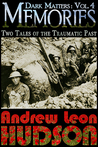
Book Review: Dark Matters: Memories by Andrew Leon Hudson

Dark Matters: Memories (Dark Matters #4)Dark Matters: Memories by Andrew Leon Hudson
My rating: 4 of 5 stars

Full disclosure: Andrew Leon Hudson is in my writers group and I have been a beta reader on several of his stories, including one that was in this volume. Still, I'll try to be objective.
Speculative fiction author Andrew Leon Hudson continues his collection of short story two-packs with this one on the theme of the Great War. The first story, "The Palimpsest", is my favorite of all his stories and follows a WWI veteran and artist as he sketches ruins in England's remote north. Strange things start to occur reminiscent of M.R. James ghost story. Hudson captures the feel of a James story quite well and the ending is powerful. Very well done.
I was less intrigued with "The Foundation", another tale of memory as it relates to the Great War. I thought the dream sequences were handled well and the overall writing was good but it lacked the punch of the other story. Perhaps I've read too much, "we must not forget" literature for this sort of thing to gut punch me anymore, especially when nothing is added to the premise. Others might find it more moving. Even if they don't, "The Palimpsest" is well worth the low price of admission.
Hudson is a writer to watch, and I hope he'll start writing longer works in the future.

View all my reviews

Friday, 8 April 2016

Military History Photo Friday: Tunnels Under the Western Front


While I'm busy writing the fourth installment of my Toxic World post-apocalyptic series, I'm also in the research phase for Under The Front, the fourth in my Trench Raiders WWI action series. In this book, the men of Company E won't be going over the top under  hail of machine gun fire or sneaking into No Man's Land in the middle of the night, instead they'll be burrowing under the German trenches.

As the Western Front stagnated and neither side could make any significant headway, new tactics evolved in an attempt to break the deadlock. One of these was digging tunnels under the enemy trench, filling them with explosives, and detonating them.

Digging these tunnels was a grueling job. The Germans and British, who were the main tunnelers, hired miners and made sure only to take the smallest men, often those who were too short to make it into regular service. Age restrictions were relaxed in order to get experienced miners. The men had to work in cramped, dark conditions, digging by hand through thick clayey soil. They had to work silently too, because the enemy would be listening. If a tunnel was detected, the opposing side would try to dig a counter-tunnel and break through. Then there would be a hellish underground fight in the near darkness.

A mine going off during the Battle of the Somme

Some of the most extensive tunnels were dug in preparation for the Battle of the Somme in the summer of 1916. This will be the setting for Under the Front, as I continue my habit of having the book written on the centenary of the events they cover.

This tactic met with varying degrees of success. Like with everything else the generals tried, it didn't prove to be a game changer, and the war dragged on for years before Germany was finally too exhausted to continue.

Photos courtesy Wikimedia Commons.
Even after a century of erosion, some of the craters made by mines at the Somme are still huge. For scale, note the people on the right edge.

Thursday, 10 December 2015

No Man's Land out now! Have a free novella!


No Man's Land, the third in my Trench Raiders series of WWI novels, has just been released. It's available on Amazon, Smashwords, and is going through Smashwords premium distribution and will soon be available everywhere. The blurb is below:

No Man’s Land—a hellscape of shell craters and dead bodies. Soldiers have fought over it, charged across it, and bled on it for a year of grueling war, but neither side has dominated it.
Until now.
An elite German raiding party is passing through No Man’s Land every night, attacking the British trenches at will. The Oxfordshire and Buckinghamshire Light Infantry need to reassert control over their front lines.
So the exhausted men of Company E decide to set a trap, a nighttime ambush in the middle of No Man’s Land, where any mistake can be fatal. But the few surviving veterans are leading recruits who have only been in the trenches two weeks. Mistakes are inevitable.

To celebrate the launch, as well as the approaching holidays, I'm putting a related novella, Christmas Truce, out for free. You can get it for free on Smashwords and most other sites. Unfortunately Amazon doesn't allow me to put it for free unless I go exclusive with them, so it's at 99 cents there. Offer ends December 31!

Christmas 1914:
In the cold, muddy trenches of the Western Front, there is a strange silence. As the men of a crack English trench raiding team enjoy their first day of peace in months, they begin to call out holiday greetings to their enemies on the German line. Soon men are fraternizing in No Man’s Land.
But when the English recognize some enemy trench raiders who only a few days before had launched a deadly attack on their position, can they keep the peace through the Christmas Truce?


Monday, 7 December 2015

No Man's Land blurb Version 2.0--Feedback Welcome!

A few days ago I posted a blurb for my upcoming novel No Man's Land, the third in my Trench Raiders series of World War One novels. Thanks for your input! Here's my revised version of the blurb. What do you think? Blurbs are tough!

No Man’s Land—a hellscape of shell craters and dead bodies. Soldiers have fought over it, charged across it, and bled on it for a year of grueling war, but neither side has dominated it.

Until now.

An elite German raiding party is passing through No Man’s Land every night, attacking the British trenches at will. The Oxfordshire and Buckinghamshire Light Infantry need to reassert control over their front lines.

So the exhausted men of Company E decide to set a trap, a nighttime ambush in the middle of No Man’s Land, where any mistake can be fatal. But the few surviving veterans are leading recruits who have only been in the trenches two weeks. Mistakes are inevitable. 


Friday, 4 December 2015

Military History Photo Friday: WWI Moroccan Soldiers Receiving Medals


This photo shows General Joffre, Commander-in-Chief of French forces on the Western Front, decorating soldiers of the French Moroccan Division in 1914 or 1915. The general is seen giving one lucky soldier a friendly peck on each cheek, a French (and North African) tradition. One of those things you have to get used to when traveling in North Africa!

It's hard to see what medal they are receiving but an enlarged image of this photo suggests that at least for the man to Joffre's right it is a Medaille Coloniale ("Colonial Medal"). That's what it looks like to me anyway, although that medal was generally given to soldiers fighting in the colonies, not colonial soldiers fighting in France! It certainly isn't the Croix de Guerre I wrote about earlier on this blog.

Anyone else out there have a guess?

Photo courtesy Wikimedia Commons.

Wednesday, 2 December 2015

Blurb Help Please!

I'm getting ready to publish No Man's Land, the third in my Trench Raiders series of World War One novels. As usual, I could use some help with the blurb, because blurbs are hard. Here it is. What do you think?


No Man’s Land—a hellscape of shell craters and dead bodies. It has been fought over, charged across, and bled on for a year of grueling war, but neither side has dominated it.
Until now.
An elite German raiding party is passing through No Man’s Land every night, attacking British trenches and setting traps. The exhausted men of the Oxfordshire and Buckinghamshire Light Infantry need to reassert control over their front lines. So the men of Company E decide to set a trap of their own, a nighttime ambush in the middle of No Man’s Land, where any mistake can be fatal.

But the few surviving veterans are leading new men barely in the trenches for two weeks. Mistakes are inevitable.

Friday, 6 November 2015

Military History Photo Friday: A WWI Medal from Morocco


As I mentioned before, I just got back from a one-month writing retreat in Tangier. I’m not much for buying souvenirs, but I do like rummaging around the city’s many little antique shops. They tend to be cramped little cubbyholes in the medina, the traditional market, shops about the size of a walk-in closet and stuffed with old bits and pieces, everything from old clocks and porcelain to stacks of mildewed books.

This sort of shop rewards a close look. Amid all the chipped plates, faded old postcards, and tarnished silverware you can find some interesting pieces, including this Croix de Guerre from World War One. This is not a rare medal. More than two million were distributed by the French government to reward bravery in battle to French and allied soldiers. At times they were given to entire regiments who had done something especially impressive.

The obverse shows a young woman wearing a Phrygian cap, symbol of the French Republic, surrounded by the words République française ("French Republic"). The back of the medal shows the dates of the conflict up to the point when they were minted: 1914–1915 then 1914–1916, 1914–1917 and finally 1914–1918. Mine ends with 1918 so it was made in the last year of the war or shortly thereafter. The cross hung from a green ribbon with seven narrow vertical red stripes. Especially brave individuals got extra attachments such as a silver palm.

Moroccan colonial troops were in the war from the start, including the Battle of the Aisne in September 1914. That’s the scene of the action in Trench Raiders, the first novel in my WWI series. The regiment I follow, the Oxfordshire and Buckinghamshire Light Infantry, fought alongside a French Colonial regiment from Morocco during that battle and so I included some Moroccans as characters. As far as I know, the Oxs and Bucks never fought alongside a Moroccan regiment again, so I’m glad I got to include them in the first book.

Who knows? Maybe this medal belonged to some Moroccan who fought at the Aisne. As the war escalated, more colonial troops flowed into the Western Front from sub-Saharan Africa and southeast Asia. More than 72,000 French colonial soldiers died during the war. You can read more about it here.

More Morocco photos coming soon once I figure out how to get them off my phone!


Saturday, 19 September 2015

Trench Raiders Book Three Finished!

My World War One novel No Man's Land is finished! Well, almost finished. I still have to do edits. Then I have to send it to my beta readers, get their feedback, chew it over, make any more corrections I want to make, get a cover, do layout, write the blurb, upload it to various retailers, and THEN it will be finished. At least the initial draft is done. I always find editing much easier than initial composition.

No Man's Land is the third full novel in my Trench Raiders series of WWI action novels and is slightly different in tone than the first two. While those were more over-the-top (pardon the pun) action, this one is more about sneaking around between the trenches at night, with our heroes playing a cat and mouse game with a German trench raiding party.

I'm glad I got this done now, because in less than two weeks I'm headed off to Tangier for a month-long writing project. Yep, it's another novel, but I don't want to talk much about it since it's still in the early stages. It will be set in contemporary Tangier, so staying there has obvious advantages. I also have to get a couple of freelance projects out of the way before I go. I always seem to be busiest before going on a trip!

Friday, 21 August 2015

Military History Photo Friday: German Artillery of World War One


I'm hard at work on No Man's Land, book 3 in my Trench Raiders series, and the guys are having a bit of trouble with German artillery. They've been mucking about in No Man's Land, trying to assert their primacy over the space between the opposing lines, and now the Germans are telling Willoughby, Crawford, and the rest of the gang what they think of their antics by lobbing over a bunch of shells.

It's only a year into the war, so the Germans are still using a lot of older field guns, like the 7.7 cm Feldkanone 96 shown above in this image courtesy Wikimedia Commons. As the name suggests, they first came out in 1896 and by 1915 were well out of date with current technology. The piece had a significant recoil that meant it needed to be adjusted after each shot, thereby reducing the rate of fire.

Most were remodeled just before the war with a recoilless system plus a new carriage and front shield. They were given the added specification n.A. (neuer Art, meaning "new model"). This model proved much more useful and was the standard German field gun throughout the first two years of the war. One can be seen in the photo below photo courtesy Drake Goodman. Both models used a crew of five, so I'm not sure who the extra guys were. Perhaps they just wanted to have their photograph taken!
These two models were specifically designed as mobile field artillery. It soon became apparent, however, that the Germans were going nowhere fast. The guns' effective range of 5,500 meters was considered insufficient and in 1916 a new model came out, the 7.7 cm FK 16 with an effective range of 9,100 meters.

It had a much longer barrel that could be brought to a higher angle, as can be seen in this Wikimedia Commons photo, and it weighed considerably more. By this point in the war mobility no longer mattered, range and destructive power did. While this proved a more useful gun, shortages in German industry by this point meant that older field guns remained in use until the end.

The average British soldier came to know these guns all too well, being on the receiving end of their shots day in and day out. In fact, they probably knew more about German artillery than their own. No one wanted to get near the artillery of their own side because it was so often a target of the enemy!

Saturday, 8 August 2015

The Rat Killer and other Weird War Tales out now!


My latest short story collection, The Rat Killer and other Weird War Tales, is out now on Amazon and Smashwords. It's going through the Smashwords system of Premium distribution and will soon be available in all major online retailers. The cover is, as usual, done by my talented brother-in-law Andrés. It looks a bit different form his regular stuff and I think it works well. The book retails for $2.99. A blurb is below.

A rat hunter on the Western Front suspects his prey are plotting against him…
A routine trip through the trenches leads to an unexpected insight…
A soldier discovers the most dangerous enemy can't be killed…
A bereaved woman performs a forbidden ritual to avenge her father’s murder…
A doomed militia is offered a path to victory that leads to damnation…

Here are five tales of war from the pen of military historian and novelist Sean McLachlan. From the bushwhackers of the American Civil War to the trenches of WWI, these stories walk the line from the strange and paranormal to the frighteningly real.

Sunday, 26 July 2015

Get my ebooks for half off!


Over at Smashwords I'm participating in their great summer/winter sale. Whether you're sweltering in the summer of the Northern Hemisphere, or chilling out somewhere south of the Equator, it's always a good time to read an ebook. Through July 31, all my ebooks at Smashwords are 50% off. You can see an entire list on my Smashwords page.

The books include my Trench Raiders World War One action series, each now $1.50; older works such as the short story collection The Night the Nazis came to Dinner and the historical fantasy The Quintessence of Absence, both $1.50; and my Civil War horror novels A Fine Likeness and The River of Desperation.

Use the coupon code SSW50 at checkout to save 50%!

Friday, 24 July 2015

Military History Photo Friday: WWI Indian troops cooking on the Western Front

 
This is an interesting image of World War One you don't generally see--some Indian cavalry troopers cooking a meal. It was taken in Estrée Blanche, France, on 25 July 1915 and is part of a massive collection of images the British Library has uploaded onto flickr. The collection, numbering more than a million public domain images that are totally free to reuse, spans every subject imaginable from old maps to children's books. It's an amazing resource for researchers, indie authors, and pretty much everyone else.

As I mentioned in an earlier post about Indian troops in World War One, the British colony contributed some 1.5 million men to the war effort. One wonders if the guys in this shot brought along some curry powder from home or if they were stuck eating the bland fare everyone else had to deal with!

You can get a large-format copy of this image here.

Friday, 10 July 2015

Military History Photo Friday: WWI German Trench in Cameroon

While the iconic image of World War One is the trench, the trenches we usually see were on the Western Front, that jagged line from the North Sea to the Swiss border. The bulk of the fighting and dying for Britain, France, and Germany was done there, and those years have been seared into the national memory. My own Trench Raiders series takes place on the Western Front. There were other fronts, however, including those in the Alps, Eastern Europe, Turkey, the Near East, and Africa.

This shot shows a German trench in Cameroon sometime between 1914 and 1916. The Germans had a number of colonies in Africa and their colonial forces fought the colonial forces of Belgium, France, and Britain. The majority of soldiers were local recruits fighting in colonial regiments. Civilians, too paid the price.

In a fascinating article on the BBC about the East Africa Campaign, the author tells how more than one million died just in that one region of the continent. No one is clear just how many died in Africa as a whole since the colonial rulers didn't bother counting.


Photo courtesy Deutsche Kolonialgesellschaft (DKG) - Koloniales Bildarchiv, Universitätsbibliothek Frankfurt am Main.

Monday, 15 December 2014

Happy Holidays! Have A Free Ebook

I'm headed to Tangier on Friday for a couple of weeks so this blog will probably go quiet until the new year. In the meantime, enjoy a Christmas story on me. I just published Christmas Truce, a novella in my Trench Raiders series of WWI books. It looks at how the men of Company E react during the real-life Christmas Truce of 1914, when British and German soldiers skipped the war for a day and met as friends in No Man's Land. The blurb is below.

Christmas 1914: In the cold, muddy trenches of the Western Front, there is a strange silence.
As a crack English trench raiding team enjoy their first day of peace in months, they call out holiday greetings to the men on the German line. Soon both sides are fraternizing in No Man’s Land.
But when the English recognize some enemy raiders who only a few days before launched a deadly attack on their position, can they keep the peace through the Christmas Truce?

You can get it as a free ebook on Smashwords or, if you have a spare $2.99 you not doing anything with, you can buy it on Amazon.


Friday, 5 December 2014

Military History Photo Friday: The Cleanest Soldier in the World

During World War One, lots of companies jumped on the patriotic bandwagon to market their products. Here's a typical ad.

So was the British soldier the "cleanest fighter in the world"? I doubt he felt that way, what with all the rats, lice, mud, and rotting bodies. But hey, they were no dirtier than any other soldier in the war!

Today the second in my Trench Raiders series of WWI action novels, Digging In, went live. It's available for $2.99 from Amazon, Smashwords, Barnes and Noble, and all other major ebook outlets. Coming soon will be a related novella about the famous Christmas Truce.

Photo courtesy Wikimedia Commons.
Looking for more from Sean McLachlan? He also hangs out on the Civil War Horror blog, where he focuses on Civil War and Wild West history.

You can also find him on his Twitter feed and Facebook page.