Showing posts with label inspiration. Show all posts
Showing posts with label inspiration. Show all posts
Tuesday, 10 December 2013


Friday, 22 April 2011
Photo Friday: Why writing is important
 As I mentioned before, I spent the past two months in Harar, Ethiopia, a fascinating medieval walled city. Before going to Harar I spent three days in Addis Ababa, Ethiopia’s capital. I’ve visited the city before but there were some things I hadn’t seen, like the Red Terror memorial. This is a museum dedicated the victims of the Derg regime, a Marxist government that assassinated the Emperor Haile Selassie and ruled Ethiopia from 1974 to 1991. This regime killed 500,000 people in its first year in power. Nobody knows the total number of victims.
Sadly, many countries have similar museums and this one has the typical displays you’d expect—walls covered with ghostly photos of victims, displays of torture methods, official documents—yet I left the museum inspired. Why? Because of this one display pictured here. It's a mimeograph machine used by a dissident. He was a scientist at an agricultural research center on the outskirts of Addis Ababa and he used this machine to print pamphlets protesting the government. He would have been executed if he had been caught so he used to bury the mimeograph in a field when he wasn't using it. After the regime was toppled he left it buried until he finally dug it up years later and donated it to the museum.
This is real writing. Writing what you believe when you risk being put up against a wall and shot. I'd like to think I'd have the courage to do this, but thankfully I don't think I'll ever be tested in this manner.
Monday, 13 December 2010
Websites for Writers: Wikileaks
 Unless you've been living on a desert island or dealing with the mother of all deadlines, you've heard of Wikileaks. This is a site that somehow manages to get its hands on hidden documents from companies and governments and publishes them on the Internet for all the world to see. Their latest (and perhaps last) coup was a huge archive of U.S. diplomatic cables and classified documents on everything from the Cuban secret service to the war in Iraq.
So why is Wikileaks on Websites for Writers, a feature showcasing sites to inspire and inform writers? Because, while the site contains no original work, it is the essence of what it is to be a writer. At their best, writers make people think; they make people see the world in a different way. With the release of these documents, we get a rare glimpse into how the U.S. government works, from mundane office bitchiness to stark assessments of geopolitics.
But being at the forefront of writing puts writers at risk. Wikilieaks has been shut out of the system. Banks, Paypal, their ISP, and many other companies have cut them off, even though nobody has been convicted (or even charged) for revealing secret documents.
And what do these "secret documents" reveal? Nothing a well-heeled traveler and follower of the news doesn't know already. Politicians say nasty things about each other when they think nobody but their cronies are listening? Yeah, I kinda figured that. More civilians died in the invasion of Iraq than the U.S. government said? Duh! The Cubans are sharing their spies with Venezuela? Obvious.
If I figured this stuff out, foreign governments with their experienced diplomats and network of experts and spies must know a hell of a lot more. So this whole kerfuffle about revealing state secrets isn't about losing face with "friends" and exposing ourselves to our "enemies", but really about the American people getting an insight into how their supposedly democratic government works.
I'm sure you've read news articles about Wikileaks. Sadly, many people haven't actually looked at the actual site because it was shut down by its ISP. Hundreds of mirror sites have sprung up with all the original content. Here's a list of Wikileaks mirror sites. These might change as the powers-that-be close them down. Go seek them out. Whatever you think about the adviseability of what Wikileaks is doing, you have a right to be informed about your world.
Thursday, 4 November 2010
Metropolis: seeing the complete classic film
 This week I went to my favorite arthouse cinema, RagTag in Columbia, Missouri, to see the restored, full-length version of Metropolis.
You've probably seen Fritz Lang's 1927 Expressionist masterpiece, and you've certainly seen some of its most famous images: a robot turning into a beautiful woman, slave workers turning the giant hands of a man-sized clock, immense machinery exploding and killing the crew. It's visually stunning and memorable, but until now it wasn't complete.
The original ran 153 minutes, too much even for the longer attention spans of a more patient age. At least half an hour was cut from most versions, and more in some cases. This left the film jumpy and at times incoherent. The extra film was considered lost until a few years ago when an original, full-length copy was found in Argentina.
The film was in bad shape and transferred to 16mm, so it had lost its original dimensions. With painstaking care, experts fixed up most of the missing parts and this almost complete version of the film is now on international tour. I say "almost complete" because a few minutes were too mangled to be restored. Even the parts that were restored are grainy and scratched. Missing scenes are explained with intertitles.
Go see it anyway. The complex and compelling plot now makes sense for the first time, and even the scratchy bits contain some alluring scenes. Lang was a master, one of the greatest directors of all time, and the Expressionist movement of the Weimar Republic created some of the most enduring silent classics in history. Seeing it actually upped my productivity as a writer. As I've mentioned before, I'm more inspired by artists in other fields than I am by writers. Seeing great DJs or painters, or even ancient ruins, gets my creative juices flowing.
[Photo courtesy Wikimedia Commons]

Monday, 1 November 2010
Websites for Writers: Shakespeare Quotes
 It's Monday, so it's time for Websites for Writers. This week's site is courtesy of enotes and is a database of famous and not-so-famous quotes from Shakespeare. Quotes are organized by theme, play, and the character who said it.
As one of the greatest writers in the English language, The Bard is eminently quotable. He seemed to have come upwith a pithy phrase to suit any occasion, from the dangers of gossip ("Done to death by slanderous tongue") to meditations on beauty ("Love looks not with the eyes but with the mind.")
Not only is his use of prose both inspiring and edifying for any writer--or reader for that matter--but you can find a quote to fit almost any situation. I've mentioned before on this blog how my Missouri Civil War novel got tied up with the whole James gang legend. Well, Frank James loved Shakespeare as many did back in those days and would often quote his favorite passages in casual conversation, or even when robbing trains! This site came in handy when writing his dialogue. It made me look much more literary than I actually am. :-)
So check out this site for quotable quotes for your own work. Shakespeare is in the public domain, so go to town!
[Photo courtesy Wikimedia Commons]

Monday, 27 September 2010
Websites for Writers: Library of Congress Prints and Photographs Reading Room
 Last week on Websites for Writers I talked about the American Folklife Center. This week I want to look at another branch of the Library of Congress, the Prints and Photographs Reading Room.
Need some visual detail for your historical novel? Need some illustrations for a nonfiction work? Looking for a writing prompt? The Library of Congress has put up thousands of historical images, many of them in the public domain. This has kept me within the art budget of more than one of my books!
The online catalog can be searched in all the usual ways. There are also themed collections, such as Civil War, baseball cards, and the Wright brothers. While most of the images are of the United States or of Americans overseas, there are also international collections, such as a beautiful series of old Japanese prints.
 They say a picture is worth a thousand words, so the ideas and information you can get from this database can help you write a library worth of books!
 [The first image is of a boy soldier of the Civil War, probably a drummer boy given a gun so he'd look cuter for the picture. The second is of a pharmaceutical lab at Howard University ca. 1900, a leading black university. The third is of the Tea-Water Canal in Tokyo, printed in 1858]
Monday, 20 September 2010
Websites for Writers: The American Folklife Center
 It's Monday, so it's time for Websites for Writers, a regular feature about non-writing websites of use to people in this crazy profession.
This week's pick is the American Folklife Center at the Library of Congress. If you're writing fiction or nonfiction set in the U.S., this webpage is for you.
Their online collections are a goldmine. The best place to start is with their illustrated guide, which points the way to many interesting pages. My favorite is the Traditional Music and Spoken Word catalog, with recordings of everything from early blues tracks to prison songs, just the thing to get you into the mood to write your next scene. Also check out the interviews with Americans the day after Pearl Harbor, and compare with those from September 11.
You can search by state, or by region and country for their international collections. The Folklife Sourcebook will point you in the direction of other collections, publishers, and societies. They even have a Facebook page!
The Library of Congress has done a grand job making a large amount of information freely available on the web. Check out their other pages too for all sorts of goodies. I'll be featuring some of them in the future.
[Photo of immigrants arriving at Ellis Island courtesy Wikimedia Commons]

Wednesday, 15 September 2010
Writing a book on Rome?
 How can a writer not be inspired by Rome? Here's yours truly in a proud moment. I'm standing at one of the entrances to St. John Lateran, leaning against the giant bronze doors that once led into the Roman Senate. They were moved here in the 17th century to grace this massive church.
This poorly framed photo taken by some Italian kid reveals one of my original historical interests--the transition from pagan to Christian in the period of Late Antiquity. How did an empire that embraced a variety of gods and showed toleration to any religion that toed the line turn into a monotheistic force that changed the direction of faith forever? I covered this in my first solo book, Byzantium: An Illustrated History, and I'd like to get back into the subject.
 Rome is a good place to study this because so many buildings from that period remain. Here's Santa Maria Maggiore, a fourth century Roman basilica converted into a church at a time when Christianity had only become the state religion within living memory. Some of the mosaics date back to 440! This was the first sight I saw in Rome and my biggest thrill. I've seen plenty of Roman sights, even hiked Hadrian's Wall, but all the ruins I had seen had been just that--ruins. Now I was actually standing inside a Roman building!
 Not far away is Santa Pudenziana, with this beautiful fourth century apse mosaic. Within a century the Romans had gone from sacrificing to Jupiter, Mithras, and the emperor, to building churches.
This period is often overlooked in tours and guidebooks, and I'm thinking of doing a history/guidebook that would tell the story of the city's transformation from pagan stronghold to Christian capital. I'd tell it in straight historical narrative, but anytime a sight in Rome fits into the story, I'll switch into guidebook mode. Thus the visitor could follow the struggle between paganism and Christianity through Rome's buildings, while the armchair traveler could simply read it as a history book.
I've done a bit of research and I haven't seen any book that does exactly what I'm proposing. I'll have to look more before making a pitch to an editor and agent, though. There's a lot of books about Rome out there!
Monday, 13 September 2010
Writing Inspiration in Rome
 I just got back from a week in Rome, and as you can see it was beautiful. I went to research photos for a book I'm doing on the Adowa campaign for Osprey Publishing. This 1896 confrontation between Italian colonial forces and the Ethiopians led to a disastrous defeat for the Italians and continuing independence for Ethiopia. While I spent much of my time in archives, I did see some of the sights.
And what sights! How couldn't a writer be inspired by Rome? Here, for example, is the arch of the Emperor Septimius Severus (ruled 193-211 AD). Set up in the Forum, it commemorates his victories over the Parthians and Arabs.
 The above scene shows the Roman army attacking the city of Seleucia on the Tigris River in what is now Iraq. Yeah, there's always been trouble in that part of the world.
 Here are a pair of winged Victories over the arch. The arch originally had statues on top of Severus in a chariot flanked by his sons Caracalla and Geta, both of whom later became emperors. I was very proud that I could identify this arch and puzzle out most of the inscription without resorting to my guidebook. All that archaeological training has paid off!
The trip was very productive. I got the rest of the photos I needed for the Adowa book, material for a series I'll write for Gadling, and plenty of extra material I'll be posting here all this week. So join me every day for Rome Week here at Midlist Writer!
Thursday, 2 September 2010
Inspiration on the street
 I'm in Oxford for the summer, and there's no town with more eccentrics than this one. Blame it on the medieval university and the good beer. The frequent public displays of affectation make great material for fictional characters.
Take last week, for instance. I'm walking to the pub and I glance into the traffic on Iffley Road. The passenger in the car nearest me is an old man in a tweed jacket and Sherlock Holmes hat, with ginger sideburns and handlebar moustache. Not too crazy by Oxford standards. Next to him, however, is a Muslim woman driving a purple VW Rabbit. She's wearing a purple headscarf and the car has purple upholstery and the back seat is covered in purple cushions. Muslim bling! A few minutes later I see a ten-year-old black boy with a Mohawk going to a wedding wearing a three-piece suit.
Fodder for characters? Oh yes, but watching the crowd for material isn't always a good thing. I was doing research in the Bodleian Library the other day and the old professor across from me was picking his nose! Imagine, some learned academic digging into his nostril with his finger up to the third knuckle before removing it and thoughtfully stroking his beard.
Then there was the public bathroom with the dirty underwear sitting on top of the urinal.
You can have those last two vignettes. I'm not going to use them. I don't write that kind of fiction. :-)
Image of nose picker courtesy Carlos Paes via Wikimedia Commons. Yes, you can find anything on that site.
Monday, 30 August 2010
Websites for Writers: The British Museum
 It's Monday, time for Websites for Writers, your weekly look at websites that can educate and inspire authors but aren't specifically about writing.
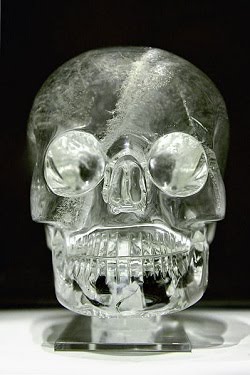
This week's site is the homepage of the British Museum. It should come as no surprise that one of the world's greatest museums has an informative and extensive website. If you're writing historical fiction or history it's an amazing resource, plus there are lots of photos of beautiful works of art and intriguing artifacts to fire your imagination. Take, for example, the so-called Aztec crystal skull, a favorite prop of fantasy novels and paranormal stories. Well, the British Museum has the real thing, or I should say the real fake since it's a modern forgery. Examination with a microscope shows that modern tools were used to make it, tools the Aztecs didn't have. Of course that just lead some hacks to claim the thing came from Atlantis! Whatever.
The cultures section offers a huge amount of real information about real cultures, rather than fantasy or New Age stuff. There are sections on just about everything else too, from the history of money (important in fictional world building) to a collection database of 1.8 million objects and online tours of various ancient cultures.
So get clicking, you're sure to find some inspiration!
Photo courtesy Rafal Chalgasiewicz via Wikimedia Commons.

Sunday, 29 August 2010
Writing advice from William S. Burroughs
While hiking the East Highland Way this month I carried The Western Lands by William S. Burroughs in my backpack. Every good hike needs a good book! One passage struck me as good advice for writers, told in typical Burroughs style.
"Cheat your landlord if you can and must, but do not try to shortchange the muse. It cannot be done. You can't fake quality any more than you can fake a good meal."
Well put!
"Cheat your landlord if you can and must, but do not try to shortchange the muse. It cannot be done. You can't fake quality any more than you can fake a good meal."
Well put!
Monday, 16 August 2010
Websites for Writers: USGenWeb
 Hello everyone! I just got back from hiking the East Highland Way in Scotland. I'll be writing this up for Gadling and will be sure to remind you once the articles go live. I've also been playing around with a bit of horror photography, which you can see by following the link. Now I'm back in Oxford and it's time once again for Websites for Writers, where I highlight a non-writing website that's inspirational or educational for writers.
This week's choice is USGenWeb, a free genealogy website. If you're writing a historical novel, or one centered around a family, be sure to check this out, especially its state-by-state database linking to branches of USGenWeb and other free sites.
The site for Missouri has given me lots of leads. There's a state and county map with clickable links, and interesting projects such as a collection of articles on colonial Missouri and photos of unknown Missourians that users are trying to identify. If these ghostly old images of forgotten faces don't conjure up a dozen stories in your head, you're chasing the wrong muse! Pages for other states have similar projects. Discussion groups can answer even the most obscure questions.
The coolest part of USGenWeb are the family homepages where people have uploaded the results of their research. These real-life family epics can provide a huge amount of inspiration for your own stories. Don't follow them too closely, though, because these heroes and heroines were real people!
Take for example the Helman family of Missouri and Oregon. This site has biographies, photos, obituaries, the story of how one of them founded a town, and little gems like a diary from 1858 and a poem from 1910. And where else would you learn that Helman is the 7,970th most popular surname in the United States?
I would be remiss to talk about genealogy without mentioning Ancestry.com. This is a pay site so I haven't explored it much, but every amateur and professional genealogist I know has an account because it has important research tools the free sites lack. Writers should be just fine with USGenWeb, though. Unless, of course, you catch the genealogy bug. . .
Ambrotype c. 1860 courtesy David Hoag via Wikimedia Commons.

Friday, 9 July 2010
When your characters change your ending
 As I've mentioned before on my travel blog, I spend part of my time in Oxford. Well, I'm back up there again and working hard on a novel partially set in the city. It's been a backburner project for a year now as I've finished a horror novel, lost a writing contest, and traveled to Africa. Now I'm back at it.
Unfortunately, the first thing I realized when I set back to work was that the ending was impossible. Not bad, not trite (although it was a bit of that) but impossible. The characters as they have developed in my mind and through the course of the story would not have the interaction that would lead to the ending I had planned.
Oh crap, it was one of the best scenes in the book! But as Stephen King says, "You got to kill your babies" and this is one baby I have to kill.
So how does my novel end? I have no clear idea. I think I'll leave it up to my characters. They got me into this mess, so it's their responsibility to get me out of it.
Thursday, 17 June 2010
Interviewed today
 Sorry for the silence this week, but my wife and I went up to Santander for a short trip. This lovely port in the northern Spanish province of Cantabria will be the subject of a post I'm doing for Gadling this weekend.
While I haven't done any blogging of my own this week, I did get interviewed on the blog of fellow writer Yolanda Sfetsos. I talk about my career and the inspiration that led me to write Dannevirke, which as far as I know is the only horror story set in the Dano-Prussian War of 1864. So click on the link on her name and check it out!
Tuesday, 1 June 2010
Thoughts on midlist writing
I recently posted about the death of Michael Pataki, a talented character actor who had roles in Star Trek and many other TV shows and films. I made a comparison with the careers of character actors and midlist writers. Lisa Glover from the Fantasy Writing Yahoo group shared these thoughts on the group and I thought they were worth reproducing here.
"I remember the scene and the actor too so thanks for posting. I took a couple of acting classes with a working actor. One of the classes he spent talking to us about the difference between being a star and an actor, and he pointed out a lot of what you did. Stars are limited in what they can do, character actors have much (less lucrative) but more fulfilling careers. He also told the group something that's stuck with me, he told anyone who wanted to be a star to stop studying acting. Stars aren't actors. Stars are a personality, they don't become a character. They don't do the interesting work an actor does.
"I think some of the 'star' writers do the same thing. They write one book over and over again. They can't step out of the genre they do and they can't shake it up. I'm not attacking them for it because, hey, they're making a lot of money writing, but pick up a John Grisham, you know what you're getting. Pick up a Laurell K Hamilton, and you know what's she's going to do. Then there are the 'starlets' here today, get the big movie deal and cash in, but never seem to carry that kind of success to the next book."
Well put, Lisa! Several midlisters have told me that while they regret not getting onto the bestseller list, they like being on the midlist. There's more freedom there. We need to embrace the term "midlister."
"I remember the scene and the actor too so thanks for posting. I took a couple of acting classes with a working actor. One of the classes he spent talking to us about the difference between being a star and an actor, and he pointed out a lot of what you did. Stars are limited in what they can do, character actors have much (less lucrative) but more fulfilling careers. He also told the group something that's stuck with me, he told anyone who wanted to be a star to stop studying acting. Stars aren't actors. Stars are a personality, they don't become a character. They don't do the interesting work an actor does.
"I think some of the 'star' writers do the same thing. They write one book over and over again. They can't step out of the genre they do and they can't shake it up. I'm not attacking them for it because, hey, they're making a lot of money writing, but pick up a John Grisham, you know what you're getting. Pick up a Laurell K Hamilton, and you know what's she's going to do. Then there are the 'starlets' here today, get the big movie deal and cash in, but never seem to carry that kind of success to the next book."
Well put, Lisa! Several midlisters have told me that while they regret not getting onto the bestseller list, they like being on the midlist. There's more freedom there. We need to embrace the term "midlister."
Friday, 21 May 2010
Michael Pataki 1938-2010
 I love B-movies.
The other day I was watching Grave of the Vampire, a little-known 1974 horror flick. While it had some low-budget flaws, like all the interior shots, including a hospital and three homes, obviously filmed in the same three rooms with the furniture moved around, it featured some good writing, tolerable acting, and a neat central idea. I won't spoil it for you. If you like B movies and/or vampires, check it out.
As usual with a movie I like, I looked it up on the Internet Movie Database and discovered that the actor who played the vampire, Michael Pataki, died last month. I read his list of roles and was impressed by how long it was, with roles stretching back to 1958 and his latest dating to this year. It turned out that even though I'd never heard his name I remembered him from my childhood.
If you grew up in a certain time and place, you loved the original series Star Trek. I know you did so don't pretend. Remember The Trouble with Tribbles, where a space station gets overrun by cute furry little creatures that hate Klingons? Both the Klingons and the crew from the Enterprise are on shore leave and while Scotty and Chekov are having a drink in the bar, a Klingon named Korax, played by Pataki, comes over to pick a fight by dissing the Enterprise.
"That sagging old rust bucket is designed like a garbage scow!" he sneers as he stands over Scotty.

"Laddie," Scotty says with a glint in his eye, "Don't you think you should rephrase that?"
"You're right, I should" Korax/Pataki says in a mocking Scottish accent. "I didn't mean to say that the Enterprise should be hauling garbage, I meant to say that it should be hauled away as garbage."
At this point little ten-year-old me knew there was a fight coming, and Star Trek fights always rocked. Sure enough Scotty, a Scotsman just like me, slowly gets up, decks Korax, and a riot breaks out.
Thirty years later I still remember that scene, and a quick look on Youtube confirmed my memory is correct.
So why am I talking about a little-known actor on a writing blog? Because Pataki was a character actor, and character actors are Hollywood's midlisters. They're the pros that can be relied on to do a good job day in and day out. They don't have star potential, but that's OK because that makes them more reliable. Today's star is yesterday's has-been, but character actors can keep working all their lives.
Just like Michael Pataki did.
I'd love to be a star, of course, and I'm sure back in the day Michael dreamed the same dreams, but being a midlister in writing or acting isn't too bad either. You can hop between genres, you can move with the winds of change without worrying about them blowing you over, and you can look forward to a lifetime of doing what you love.
And maybe someday I'll create a scene that everyone will remember thirty years after they read it.
Monday, 17 May 2010
Websites for Writers: New England Antiquities Research Association
 Welcome to today's installment of Websites for Writers, where we look at sites that can inspire and inform your writing. If you want straightforward writing advice, I suggest Writing-World. Here you'll get something a little different.
Today we're looking at the New England Antiquities Research Association, a collection of amateur archaeologists, historians, and linguists with some very different ideas about New England's past. In fact, they have a whole range of ideas, united only by the belief that traditional archaeology doesn't have all the answers. The group focuses on unusual stone sites in New England. Some look like European dolmens, others are strange meandering piles of stone, others are small stone enclosures.
Some believe these sites prove that ancient Old World civilizations visited New England. Others say they're traces of a previously unrecorded advanced civilization. Some see them as Native American or evidence of a lingering paganism among Colonial settlers.
Professional archaeologists dismiss these claims and say the structures date to Colonial times, with some simply being natural formations. I have a Master's degree in archaeology, worked in the field for ten years, and have examined several of these sites, and I tend to agree. Much New Age archaeology is rooted in racism and sites such as America's Stonehenge are almost certainly early modern.
But we're writers, and we shouldn't let facts get in the way of inspiration. A look through NEARA's collection of photos and articles can inspire a whole library of story ideas. These unexplained monuments can provide a mysterious setting for your story, or even the central focus. Imagine a Dan Brown-style thriller where a fearless researcher uncovers the "truth" about New England's past, or a Lovecraftian horror where the old gods worshiped at these sites rise from their slumber, or historical fiction where a settler becomes curious about these sites and gets accused of witchcraft. Beyond story ideas, what this website teaches us is that there's always more than one way to look at a body of evidence, that the past is owned and used by the present for its own purposes. And all of our characters have a past.
For a good primer, check out Daniel V. Boudillion's Picture Glossary of New England Lithic Constructions. I like this website because Boudillion takes a more pragmatic view, seeing the sites as a mixture of Native American, Colonial, Neopagan, and just plain inspiring.
Image of the Oley Hills site southwest of Allentown, Pennsylvania, courtesy Wikimedia Commons.

Friday, 2 April 2010
Writing on the road
 After a two-month hiatus, this blog is back up and running. I've been in Ethiopia and Somaliland for work and what with slow Internet connections and the distractions of seeing two fascinating countries I haven't had time to post here. I'll be posting regularly from now on.
I was in Ethiopia to research a book on the Battle of Adowa for Osprey Publishing. This decisive victory over the Italians was one of the greatest defeats of a European force at the hands of an African army and made Ethiopia the only African country never to be colonized. I met a lot of historical experts, including Dr. Hiluf Berhe of Axum University, who wrote his thesis on the battlefield. He and I spent a long, enjoyable, and exhausting day walking the battlefield and climbing up mountains. I also found some books on the period that are unavailable outside of Ethiopia and did some research at the Institute of Ethiopian Studies, housed in Haile Selassie's old palace. I've never worked in a palace before! This book is going to be a good one, and would have been impossible to do properly if I hadn't gone to the country.
I'm also doing a series for Gadling. My travel articles on Ethiopia are already going online, and when that series is done in about a month I'll be doing another series on Somaliland, a breakaway republic in northern Somalia that has created a haven of peace and commerce while the rest of former Somalia continues to suffer chaos and bloodshed.
Writing on the road is something I've always loved, since it combines my two great passions. I left my laptop behind and wrote longhand. This kept me stress-free about losing my computer and allowed me to get reacquainted with good old-fashioned paper.
As tired as I was, I still wrote every day. This is an important thing for writers to do, not only to keep in practice and accrue a large body of work, but to stay in tune with your muse. Of course, staying in tune with your muse isn't exactly difficult when you're meeting nomads, exploring ancient cave art (like I'm doing in the photo), and visiting medieval walled cities. Sharing my travel stories is what got me into writing in the first place back in my zine publishing days.
Sometimes I think that writers never get vacations. Even so, it's a hell of a fun job!
This photo shows me at the cave art site of Lass Geel, Somaliland, and was taken by Swedish photojournalist Leo Stolpe. Thanks Leo!
Thursday, 24 December 2009
Crashing after my deadline
I'm in my usual end-of-the-year slump. Like last December, I just finished a book for Osprey Publishing. This one was called Medieval Handgonnes: The First Black Powder Infantry Weapons. It was a lot of fun but a lot of work too, because until I wrote one, there was no book on Europe's first two centuries of firearms. I had to do tons of hands-on research at museums and archives.
Now I'm in a lull. I always have an energy crash after a deadline, and with no big deadlines for the next few months I can sit back, take stock, and plan out 2010. While writers need to keep up productivity and constantly look for new markets, it's also important to take some time out and reassess. The holiday season is a good time for that. It's not like publishers are going to answer your emails on Christmas Eve!
Happy Holidays everybody!
Now I'm in a lull. I always have an energy crash after a deadline, and with no big deadlines for the next few months I can sit back, take stock, and plan out 2010. While writers need to keep up productivity and constantly look for new markets, it's also important to take some time out and reassess. The holiday season is a good time for that. It's not like publishers are going to answer your emails on Christmas Eve!
Happy Holidays everybody!
Subscribe to:
Posts (Atom)