Showing posts with label websites for writers. Show all posts

Wednesday, 3 August 2022

A New Website and other News

I've got a new website! It's been a while since I had one, so I hired designer Stuart Grant to design a website for author Sean McLachlan. I think it looks pretty good. It's still being tweaked, though, so if you have any suggestions, feel free to add them in the comments section.

In other news, I'm back in Oxford for my usual summer research in the Bodleian Library. This year I'm doing research for my upcoming Weimar historical mystery series, as well as some reading on the Sudan in anticipation of a trip there in the winter. Fingers crossed on that one.

On the 16th of this month I'll be releasing the next issue of Sean's Travels and Tales, my monthly newsletter that comes out on the 16th of every month. If you sign up via my website, you also get two of my books, Radio Hope and Tangier Bank Heist, for free! Not a bad deal, eh?

Monday, 13 December 2010

Websites for Writers: Wikileaks

Unless you've been living on a desert island or dealing with the mother of all deadlines, you've heard of Wikileaks. This is a site that somehow manages to get its hands on hidden documents from companies and governments and publishes them on the Internet for all the world to see. Their latest (and perhaps last) coup was a huge archive of U.S. diplomatic cables and classified documents on everything from the Cuban secret service to the war in Iraq.

So why is Wikileaks on Websites for Writers, a feature showcasing sites to inspire and inform writers? Because, while the site contains no original work, it is the essence of what it is to be a writer. At their best, writers make people think; they make people see the world in a different way. With the release of these documents, we get a rare glimpse into how the U.S. government works, from mundane office bitchiness to stark assessments of geopolitics.

But being at the forefront of writing puts writers at risk. Wikilieaks has been shut out of the system. Banks, Paypal, their ISP, and many other companies have cut them off, even though nobody has been convicted (or even charged) for revealing secret documents.

And what do these "secret documents" reveal? Nothing a well-heeled traveler and follower of the news doesn't know already. Politicians say nasty things about each other when they think nobody but their cronies are listening? Yeah, I kinda figured that. More civilians died in the invasion of Iraq than the U.S. government said? Duh! The Cubans are sharing their spies with Venezuela? Obvious.

If I figured this stuff out, foreign governments with their experienced diplomats and network of experts and spies must know a hell of a lot more. So this whole kerfuffle about revealing state secrets isn't about losing face with "friends" and exposing ourselves to our "enemies", but really about the American people getting an insight into how their supposedly democratic government works.

I'm sure you've read news articles about Wikileaks. Sadly, many people haven't actually looked at the actual site because it was shut down by its ISP. Hundreds of mirror sites have sprung up with all the original content. Here's a list of Wikileaks mirror sites. These might change as the powers-that-be close them down. Go seek them out. Whatever you think about the adviseability of what Wikileaks is doing, you have a right to be informed about your world.

Monday, 29 November 2010

Websites for Writers: Piers Anthony

It's Monday, so it's time for another website for writers. Today we're looking at Hi Piers, the official homepage of Piers Anthony.

In the unlikely event you haven't heard of him, Piers Anthony is a longtime author in many genres. He's most famous for the Xanth series of humorous fantasy, but he's also written science fiction, horror, and an increasing amount of erotica.

Piers has seen it all, and luckily for us tells it all. He's famous in the writing community for tangling with editors and even suing when he felt he was being wronged. Because of this, he's been blacklisted by many publishers. He says that no major house is interested in his work except for the bestselling Xanth series. To make sure his several novels a year see the light of day, he has resorted to various small presses and epublishers.

Of greatest practical use to aspiring writers is his no-holds-barred review of epublishers and vanity presses that he updates every month. Cheated writers often tell him their stories, which he then posts online, although he's always fair-handed when it appears the writer has unrealistic expectations of their publisher.

For inspiration, check out the section on books by Piers Anthony. He's published more than 140 in the past 50 years! This is what persistence and a solid work ethic will get you.

Also of interest is his newsletter, where he talks about his life, what he's reading, and his views on publishing. At times his views of the publishing industry seem to me to be overly negative, but then again he's been in this crazy business forty years more than I have, so maybe I'll feel that way some day. He's also a strong advocate of self-publishing, once being a co-owner of Xlibris. In his latest newsletter he states, "I think of mutation, wherein 99% of the changes may be deleterious, even lethal, but the 1% that survive power the forward evolution of all living things. We would not be here today without mutation. Editors reject 99%, but the 1% they accept is not necessarily the best; natural selection operates imperfectly in publishing. So yes, we need self publishing, even if it is 99% bad, for the sake of the 1% that may otherwise be lost."

Good point, but I think that for most writers self-publishing is a bad idea.

While I don't always agree with what Piers has to say, I always check out his newsletter and value his insights. It's rare to find a writer so brutally honest about the business.

Monday, 15 November 2010

Websites for Writers: UNESCO's list of Intangible World Heritage

We're all familiar with UNESCO's World Heritage List, which showcases manmade and natural wonders of global importance. A lesser-known list is UNESCO's list of Intangible World Heritage, which showcases rare and unique cultural practices like the human towers of Catalonia.

Why have I picked this site for this week's Websites for Writers? Because of the incredible breadth of human experience and creativity this list encompasses. There's everything from Tibetan throat singing to New Year's celebrations in Iran, which involves jumping over fires and streams.

It's not all exotic locales either. France has five entries on the list, including traditional timber-frame construction and processions involving huge effigies of giants and dragons.

There are hundreds of practices that can inspire your next story or act as leads for nonfiction articles (like the human towers I wrote about for Gadling, link above). Novelists and short story writers will find plenty of local color to use as their characters travel the world. Perhaps your next mystery novel involves a member of a human tower plunging to his death in suspicious circumstances. Or a fantasy writer could explore the true reasons behind why the French parade around with giant paper maché dragons.

The list is searchable by country and full text, so you can easily find a weird cultural practice that fits with your story.


[Photo courtesy user Baggio via Wikimedia Commons]

Monday, 8 November 2010

Websites for Writers: The Institute of Ethiopian Studies

It's Monday, so it's time for another website to inspire all you writers out there. This week we're looking at the Institute of Ethiopian Studies, where I spent part of this year researching a book on the Adowa campaign of 1896 for Osprey Publishing. Now this site won't be of much practical use to you unless you're writing about Ethiopia (if so, get in touch) but it sure is inspiring.

The institute is on the campus of Addis Ababa University in one of Haile Selassie's old palaces. The reading desks are in a giant, ornately decorated room that looks like it was used for state functions. It's the nicest room I've ever researched in! Founded in 1963, the institute has weathered coups, civil wars, famine, and lack of funding yet has continually produced two journals as well as a host of other monographs, books, and collections of academic papers. The staff have assembled a huge collection of works on Ethiopia and surrounding countries. Upstairs is an extensive and well-organized ethnographic museum that's one of the highlights of any visit to the city.

Conducting research here was a delight. Despite some problems with language barriers the staff was very helpful and the large amount of English-language material was invaluable for my book. While many people in the West think of Ethiopia in terms of the television images of war and famine from the Eighties, Ethiopia is on the rise. The UN recently ranked Ethiopia number one in Africa in improving quality of life in the past forty years, and number eleven worldwide. One criterion the Ethiopians scored highly on was improvements to education, and their excellent institute is part of that positive trend.

The campus itself is a pleasant place with the usual attractive coeds and lush gardens. Plus there's this cool cafe made from a converted London Routemaster! I ate lunch there a few times. Their Ethiopian food was good, of course, and they also made tasty chips and salsa.

So remember, writers, the so-called developing world is rich with scholars and libraries. They may not have a lot of money, they may only have a dialup connection, they may lose power a couple of times a day, but they keep researching and writing books.

So. . .what YOUR excuse for not writing today?

[Image of institute courtesy Yigal Chamish. I took two photos of it but can't find them! The Routemaster shot is by my wife Almudena Alonso-Herrero]

Monday, 1 November 2010

Websites for Writers: Shakespeare Quotes

It's Monday, so it's time for Websites for Writers. This week's site is courtesy of enotes and is a database of famous and not-so-famous quotes from Shakespeare. Quotes are organized by theme, play, and the character who said it.

As one of the greatest writers in the English language, The Bard is eminently quotable. He seemed to have come upwith a pithy phrase to suit any occasion, from the dangers of gossip ("Done to death by slanderous tongue") to meditations on beauty ("Love looks not with the eyes but with the mind.")

Not only is his use of prose both inspiring and edifying for any writer--or reader for that matter--but you can find a quote to fit almost any situation. I've mentioned before on this blog how my Missouri Civil War novel got tied up with the whole James gang legend. Well, Frank James loved Shakespeare as many did back in those days and would often quote his favorite passages in casual conversation, or even when robbing trains! This site came in handy when writing his dialogue. It made me look much more literary than I actually am. :-)

So check out this site for quotable quotes for your own work. Shakespeare is in the public domain, so go to town!


[Photo courtesy Wikimedia Commons]

Monday, 25 October 2010

Websites for Writers: Castles of Britain

Everybody loves castles, especially writers. They make a fine backdrop for vampires, romance, or just some good old fashioned medieval bloodletting. There are a wealth of castle websites out there but one of my favorites is Castles of Britain by castle expert Lise Hull.

Lise has put her years of study to good use in this well-organized site. It provides a complete run-down of the basics of castle history and architecture with numerous examples of individual castles in the British Isles. There are literally hours of reading here. If you're more of a visual writer go to the castle photo gallery for lots of inspiring photos. The Castle Learning Center has plenty of good information about castle construction, development, personnel, and daily life, and there's even an online course if you want to learn more.

So check it out if you want to add to the ever-growing body of literature of, about, or including castles. I recently added my own fuel to the fire with an article on castles in Yorkshire.

In case you're wondering, the lovely little island fort pictured above was built by Alexander Stewart, the infamous "Wolf of Badenoch ", on Loch Gamhna near Aviemore, Scotland. I talk more about that in my last article in my series on hiking the East Highland Way.

Monday, 18 October 2010

Websites for Writers: American Folklore

It's Monday, so it's time for Websites for Writers, when we look at sites to inform and inspire all you scribblers out there in Internetland.

This week we're looking at American Folklore, a massive collection of folktales, jokes, rhymes, tongue twisters, and much more. The first thing I liked when I started looking at this site is that it has sections for Canada, Mexico, and Latin America. Nothing annoys people outside the U.S. more than to hear "American" used solely for people within the U.S. It's nice this site recognizes there are lots of countries in the Americas.

Author S.E. Schlosser has collected an impressive array of folk treasures. Got a story set on the railroad? There's a whole section devoted to railroad folklore. Need some tall tales or pithy expressions about local weather? Go to weather folklore. Have some Native American characters? Check out these Native American tales. Of course there's a large collection of ghost stories and monsters, but how many sites give resources for ESL readers? There's even a bizarre tale about Henry Hudson meeting some gnomes.

You can search by subject or state and you're sure to find something to enrich your story, whether historical or contemporary. This is also a great resource for nonfiction writers. So go check it out, just make sure you don't get sucked in and spend the whole day reading instead of writing!

Bigfoot shot courtesy Wikimedia Commons.

Monday, 11 October 2010

Websites for Writers: First Kill documentary

A lot of novels are about war, and many history books cover war too. As writers we need to understand war and our attraction to it, but can it really be understood without being in one?

I recently watched a harrowing documentary about Vietnam titled First Kill. There are some graphic images here, and some unpleasant truths, yet it's one of the most important documentaries I've ever seen and I highly recommend it.

"If war were hell, and that was all there was to the experience. . .I don't think people would continue to make war," says Michael Herr, former war correspondent and screenwriter of Apocalypse Now and Full Metal Jacket.

The several veterans interviewed in this documentary seem to agree. While they all admit to fear, they all seem to have enjoyed it to a certain extent. There's a certain lure to sanctioned killing that pulls people and whole societies into fighting again and again. Few show much regret even when they reminisce about killing children or taking Vietcong ears as trophies.

Intercut with the interviews are images of tourists, most of whom had probably never heard a shot fired in anger, visiting the Vietcong tunnels and American torture chambers. Their fascinated faces are a strange contrast to the haggard looks of some of the veterans, yet the veterans talk about their experiences as a sort of peak experience, when all their senses were at their highest level.

"One does not have to learn how to survive in a jungle, those things is already there," says one veteran, who says that not only did his sight and hearing become more acute, but he developed a sixth sense for danger and a heightened libido.

"Everything is full throttle," he says.

Kerr says, "It can't be an accident that the bloodiest century in history was also the century of the movie camera. I've heard for years that pathetic claim by television journalists that because it was on the news every night that they were responsible for shortening the war. My feeling is that they were actually instrumental in prolonging it."

A telling exchange comes near the end. As one of the veterans arranges a small pile of pills with a trembling hand, he says he wishes the government would send him back to Vietnam.

"Why?" the interviewer asks.

"I miss it," he says.

Photo of Vietnamese prisoners courtesy U.S. Army.

Monday, 4 October 2010

Websites for Writers: AuthorsDen

Last week I got an Authorsden page. AuthorsDen is a site where authors can market their books and post articles, fiction, poetry, and blogs.

So why did I get an AuthorsDen account when I'm paying a web designer to make a personal site and I already have a successful blog? Because you can never have too much publicity. AuthorsDen is a community of authors numbering in the thousands. My rather basic site, listing my books and a few news posts, has gotten more than 200 hits in less than a week. People obviously read AuthorsDen.

Plus it's free. Well, the cheap account is free, and that's rather limited. With my bio, seven book listings, and two news announcements I've already used 71% of my space! I'll have to start deleting old announcements pretty soon, and after a couple more years of book publishing I won't have any more room at all! Like most free pages, AuthorsDen offers various levels of paid membership to get more features. Bronze is the cheapest and costs $40 a year. That gets you 2 megs storage capacity as well as a blog, newsletter, and a couple other features. There are three more levels all the way up to platinum, which costs $1,200 and gets you featured on the front page. I bet platinum members get a lot of hits, although I'm not sure how many of these hits turn into sales.

Which brings me to a problem with AuthorsDen. To a great extent it's a promo op for self-publishers. I've talked about the downsides to self-publishing before. Most of these authors don't have an audience, and I'm getting the impression that the site is mostly used by its members. That's not a bad thing, since writers are usually avid readers, but it feels like a bit like a closed group, much like many of the Yahoo discussion groups.

Still, having another platform is worth the effort I put into it. Setting up my site took less than two hours and cost me nothing. I've found a few other pros like Dianna Graveman so it's not all self-pub oblivion, and it helps my SEO. Who knows? Maybe I'll get a few sales too. A little extra push is always a good thing in this game.

Yes, I know this Websites for Writers series is supposed to feature nonwriting sites of use to writers, but the only one I found last week is turning into an article for Gadling. Since they pay me and this blog doesn't, it's ending up there. I love y'all, but business is business!

Monday, 27 September 2010

Websites for Writers: Library of Congress Prints and Photographs Reading Room

Last week on Websites for Writers I talked about the American Folklife Center. This week I want to look at another branch of the Library of Congress, the Prints and Photographs Reading Room.

Need some visual detail for your historical novel? Need some illustrations for a nonfiction work? Looking for a writing prompt? The Library of Congress has put up thousands of historical images, many of them in the public domain. This has kept me within the art budget of more than one of my books!

The online catalog can be searched in all the usual ways. There are also themed collections, such as Civil War, baseball cards, and the Wright brothers. While most of the images are of the United States or of Americans overseas, there are also international collections, such as a beautiful series of old Japanese prints.
They say a picture is worth a thousand words, so the ideas and information you can get from this database can help you write a library worth of books!
[The first image is of a boy soldier of the Civil War, probably a drummer boy given a gun so he'd look cuter for the picture. The second is of a pharmaceutical lab at Howard University ca. 1900, a leading black university. The third is of the Tea-Water Canal in Tokyo, printed in 1858]

Monday, 20 September 2010

Websites for Writers: The American Folklife Center

It's Monday, so it's time for Websites for Writers, a regular feature about non-writing websites of use to people in this crazy profession.

This week's pick is the American Folklife Center at the Library of Congress. If you're writing fiction or nonfiction set in the U.S., this webpage is for you.

Their online collections are a goldmine. The best place to start is with their illustrated guide, which points the way to many interesting pages. My favorite is the Traditional Music and Spoken Word catalog, with recordings of everything from early blues tracks to prison songs, just the thing to get you into the mood to write your next scene. Also check out the interviews with Americans the day after Pearl Harbor, and compare with those from September 11.

You can search by state, or by region and country for their international collections. The Folklife Sourcebook will point you in the direction of other collections, publishers, and societies. They even have a Facebook page!

The Library of Congress has done a grand job making a large amount of information freely available on the web. Check out their other pages too for all sorts of goodies. I'll be featuring some of them in the future.


[Photo of immigrants arriving at Ellis Island courtesy Wikimedia Commons]

Monday, 30 August 2010

Websites for Writers: The British Museum

It's Monday, time for Websites for Writers, your weekly look at websites that can educate and inspire authors but aren't specifically about writing.

This week's site is the homepage of the British Museum. It should come as no surprise that one of the world's greatest museums has an informative and extensive website. If you're writing historical fiction or history it's an amazing resource, plus there are lots of photos of beautiful works of art and intriguing artifacts to fire your imagination. Take, for example, the so-called Aztec crystal skull, a favorite prop of fantasy novels and paranormal stories. Well, the British Museum has the real thing, or I should say the real fake since it's a modern forgery. Examination with a microscope shows that modern tools were used to make it, tools the Aztecs didn't have. Of course that just lead some hacks to claim the thing came from Atlantis! Whatever.

The cultures section offers a huge amount of real information about real cultures, rather than fantasy or New Age stuff. There are sections on just about everything else too, from the history of money (important in fictional world building) to a collection database of 1.8 million objects and online tours of various ancient cultures.

So get clicking, you're sure to find some inspiration!


Photo courtesy Rafal Chalgasiewicz via Wikimedia Commons.

Monday, 23 August 2010

Websites for Writers: Ian Allan Publishing

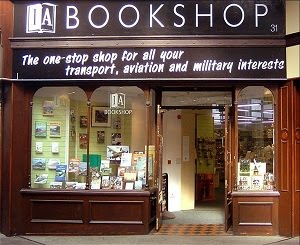
This week on Websites for Writers we're looking at the homepage of specialist publisher Ian Allan Publishing. I've never worked for Ian Allan and probably never will, but like any writer familiar with them I'm impressed by their success.

First off, they're long-lived. They've been around since 1942. They're also successful, with thousands of books in their backlist, excellent brand recognition, good distribution, loyal readership, retail stores, and dominance in several genres.

So what do these guys publish? Nothing you'd have ever heard of unless you have the right obsession. Do you have a copy of London Transport in the 1960s on your shelf? How about Messerschmitt Bf109 at War? Maybe a subscription to Bus & Coach Preservation Magazine?

Ian Allan does not publish bestsellers. They don't even try to publish bestsellers. Instead they focus on transport, aviation, military hardware, modeling, and Masonic books. Why? Because there are a lot of people out there who love these subjects, and they loyally support companies that publish books about their enthusiasms.

So even if Ian Allan doesn't sell a lot of copies of A Dictionary of Passenger Ship Disasters, they'll have published something that someone really wants to read. And the sheer number of their books shows just how many of these micro-genres there are. Hundreds of titles on UK steam engines. More than a hundred on canals. Books on buses. Books on helicopters. Books on collecting WWII medals.

So check out Ian Allan's website to be reassured that no matter how obscure your subject, there's a publisher for you.


Image courtesy Martin Faulks via Wikimedia Commons.

Monday, 16 August 2010

Websites for Writers: USGenWeb

Hello everyone! I just got back from hiking the East Highland Way in Scotland. I'll be writing this up for Gadling and will be sure to remind you once the articles go live. I've also been playing around with a bit of horror photography, which you can see by following the link. Now I'm back in Oxford and it's time once again for Websites for Writers, where I highlight a non-writing website that's inspirational or educational for writers.

This week's choice is USGenWeb, a free genealogy website. If you're writing a historical novel, or one centered around a family, be sure to check this out, especially its state-by-state database linking to branches of USGenWeb and other free sites.

The site for Missouri has given me lots of leads. There's a state and county map with clickable links, and interesting projects such as a collection of articles on colonial Missouri and photos of unknown Missourians that users are trying to identify. If these ghostly old images of forgotten faces don't conjure up a dozen stories in your head, you're chasing the wrong muse! Pages for other states have similar projects. Discussion groups can answer even the most obscure questions.

The coolest part of USGenWeb are the family homepages where people have uploaded the results of their research. These real-life family epics can provide a huge amount of inspiration for your own stories. Don't follow them too closely, though, because these heroes and heroines were real people!

Take for example the Helman family of Missouri and Oregon. This site has biographies, photos, obituaries, the story of how one of them founded a town, and little gems like a diary from 1858 and a poem from 1910. And where else would you learn that Helman is the 7,970th most popular surname in the United States?

I would be remiss to talk about genealogy without mentioning Ancestry.com. This is a pay site so I haven't explored it much, but every amateur and professional genealogist I know has an account because it has important research tools the free sites lack. Writers should be just fine with USGenWeb, though. Unless, of course, you catch the genealogy bug. . .

Ambrotype c. 1860 courtesy David Hoag via Wikimedia Commons.

Monday, 26 July 2010

Websites for Writers: Fantastic Fiction

It's Monday, which means it's time for Websites for Writers, where we look at websites that inform and inspire writers. This week we're featuring Fantastic Fiction.

This database includes more than 30,000 authors and more than 350,000 books. It's not comprehensive (not even Books in Print can boast that) but it makes for some pretty interesting surfing. Not only can you look up lesser-known authors, like sf writer Mark Geston, and find out that his long out-of-print titles have recently been rereleased in an omnibus edition, but you can make new discoveries too. Right above this old favorite of mine was comedian Ricky Gervais, who wrote a series of children's books. The list is fiction only, so yours truly isn't on it (sniff), but there's a Patricia MacLachlan who has written 35 children and YA books.

The website also includes a Coming Soon section and lists of award-winners and series. You also get to see lots of nice cover art and even reading suggestions from the authors themselves.

The most inspiring thing about this list is its vastness--thousands of authors writing hundreds of thousands of books! There's room enough for everybody. It's inspiring to see how long some of these folks endure. Mrs. MacLachlan started her publishing career in 1979 and just came out with a new book this year. She was writing kids books when I was a kid. Now I'm the father of a book-hungry kid of my own and she's still going strong!

Websites for Writers will take a break for the next couple of weeks. I have a deadline next Monday and the following day I'm heading up to Scotland to hike the East Highland Way. I'll be blogging more this week though, so come on back.

Monday, 19 July 2010

Websites for Writers: The Lionel Fanthorpe Appreciation Page

I wrote a 1,000 words today!

Big deal. Even if I had written twice that it would be nothing compared to the average workday of Lionel Fanthorpe.

Never heard of him? Neither had I until a few months ago when I went to a writing convention and picked up the odd little paperback pictured here by "Bron Fane", one of Fanthorpe's numerous pen names. Turns out he's the most prolific science fiction author ever, with more than 180 novels. He's also written dozens of nonfiction books, countless short stories, and God knows what else.

God should know, because he's an Anglican minister too.

The Lionel Fanthorpe Appreciation Page
celebrates the career of a truly dedicated writer. Back in the 1950s, Badger Books flooded the market with cheap novels to tap into the burgeoning paperback market. They only offered writers 25 pounds a pop, and while that bought far more back than than it does today, it was still a crap wage. But that didn't dissuade Mr. Fanthorpe. He calculated that if he wrote a novel a week, he'd make a hundred quid a month--not much but better than the dole.

So that's exactly what he did. He had no time for complex plots, deep characterization, or elaborate ideas, he simply drew from his wide reading in the occult and paranormal to make wild tales of science fiction, fantasy, and horror.

Badger Books provided him a reel-to-reel recorder, and covering himself with a blanket to help his concentration, he told the machine whatever came into his head. When he thought he was done, he'd send the recording off to a typist who would hammer it out and tell him how close he was to the 158-page target. Sometimes he'd discover he only had a few pages left, and suddenly our heroes would solve all their problems with a brilliant plan, or no plan at all, or sometimes the story would simply stop. If he came up short, his amazing talent for padding would come to the fore and characters would yammer on about random topics for a few pages before the plot would continue. Just check out his agonizingly long description of a character brushing her teeth.

The amazing thing is with this rush to production is that Fanthorpe never fell into cliche. Clunkiness often, incoherence sometimes, but never a tired line. What other writer would describe a hand as a "cluster of leathery bananas"?

Because of this Fanthorpe's novels are never boring. I'm not saying they're good literature, but they are certainly fun. So give him a try, and remember that with enough concentration, you too can write a crazily bad yet entertaining novel in a week.

Monday, 12 July 2010

Websites for Writers: Baby Names Meanings

It's Monday, so it's Websites for Writers day, when I share a website useful for firemen, um, I mean writers. Anyway, I've had a long Monday, did a bunch of blogging, 1000 words of fiction, a bit of editing, it's eleven o'clock at night, and Sydney Poitier is on TV, so I'm going to keep this short. Baby Names Meanings is a database of more than 40,000 names with their meanings. There are the usual names of Western culture, and more international ones like Yiddish, Arabic, even Armenian. Very useful for finding names for your characters, something I've always been bad at. And since names always seem to fit a person, you can pick through the definitions to find something perfect.
That's a wrap. Poitier is going to kick some small-town ass in The Heat of the Night. See y'all later!

Monday, 5 July 2010

Websites for Writers: Burtoniana

Sir Richard Francis Burton has always been one of my personal heroes. The famous nineteenth century explorer was a linguist, naturalist, fighter, lover, early anthropologist, and writer. He's famous for sneaking into Mecca posing as a Muslim and contributing to the discovery of the source of the Nile. He was also surprisingly open-minded and multicultural for his time, although he wasn't afraid of criticizing a culture's faults, including his own.

Burtoniana is an excellent website dedicated to his life and work. Writers can get a lot out of this site. It's filled with detailed descriptions of Burton's travels in Africa, Asia, the Middle East, and South America, perfect for someone penning a historical tale or wanting inspiration for creating a fantasy world with some real cultural basis. Burton's style was intellectual without being dry, adventurous without being exaggerated, and clear without being condescending.

He also wrote every day. It didn't matter if he was covered in boils, hadn't eaten in three days, and was being chased by angry tribesmen, he still wrote every day. This is his true inspiration for writers. If he could be half dead and lost a thousand miles from home, and still churn out a thousand words of good prose in a single morning, what's your excuse?

Monday, 21 June 2010

Websites for Writers: Northern Earth

After a deadline-induced hiccup last week, we're back to our regular Monday post of Websites for Writers, a look at websites that can inform and inspire writers in unexpected ways.

This week's pick is Northern Earth, the site for the UK magazine of the same name and one of the main neo-antiquarian magazines. Neo-antiquarianism is the study of the ancient landscape from a spiritual perspective, an attempt to understand how ancient civilizations perceived the world. It's a broad field, encompassing a range of disciplines from academic archaeology to fringe studies such as UFOs and ley lines.

For neo-antiquarians, belief or disbelief is of secondary importance to interpretation. These folks love their land, and want to understand how it was used and appreciated by generations past. A little creative academia is OK too. Being British, they generally don't take themselves too seriously!

So how is this site useful for writers? First off, the articles from the back issues are a treasure trove of ideas, from rare nuggets of folklore to overwrought systems of magic. Some articles are stories in the making, like the Corpse Watcher and the Legend of Mayburgh Henge.

Fantasy and historical writers will find this site especially interesting. SF, horror, and gothic writers will get a lot out of it too. Plus the various competing theories show how the same information can be interpreted in widely different ways. Anyone dealing with a host of characters will come up against this phenomenon!
Looking for more from Sean McLachlan? He also hangs out on the Civil War Horror blog, where he focuses on Civil War and Wild West history.

You can also find him on his Twitter feed and Facebook page.